REEF REVIEW
Updated: Aug 17
It's time for another reef update as the Australian Institute of Marine Science just dropped their latest summary report of coral reef condition for 2025/26. But first let’s provide some context from a decade ago:
So how do things look, now a whole decade after declarations of the apocalypse? Well, coral cover over most of the Great Barrier Reef has increased significantly above long-term averages. Coral cover remained unchanged on most reefs (56%) over the last year, while more than a quarter (28%) saw increases and just 16% saw declines.
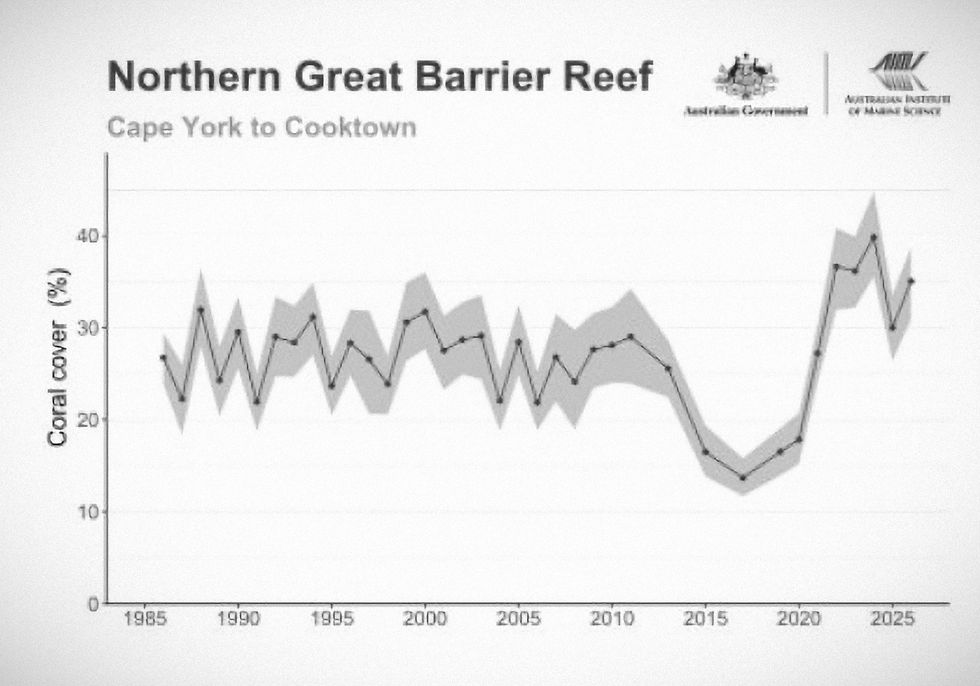
Since reporting began in the 1980s the northern region saw regular coral cover die-offs and increases of about ten percent, but sticking to an average between 22% and 32%. After a dramatic collapse to below 15% in 2016 the norther reef has seen record high coral cover with four of the last five years being above any previous highs, up to 40%.
The central reed was historically much more stable but hovered between 15% and 20% cover until recent years. After a jump to 30% coverage in 2016 and decline to 14% over the next few years, the central reef has seen coral cover far above historical levels, hovering up around 32% over the last six years.

Coral cover on the southern reef has been highly variable for as long as we've had records, with levels over 40% in the late '80s and early '90s, dropping down to 25-35% for a decade before collapsing to almost 10% in 2011. Since then the trend has been up, averaging roughly 32% but with big swings each year.

The report’s key takeaways were:
Recovery in the three regions had been primarily, but not exclusively, driven by fast-growing but vulnerable corals. It continued despite mass bleaching events in 2020 and 2022. These were less intense than the 2016 and 2017 events, showing that mass coral bleaching events do not always lead to widespread mortality.
Over the 2024 Australian summer, widespread, record heat stress caused the fifth mass bleaching event since 2016. This event, together with wave damage and associated flooding from two severe tropical cyclones and ongoing crown-of-thorns outbreaks, caused these high levels to decline sharply.
Another mass bleaching event occurred on the Great Barrier Reef during the summer of 2025. This event was less extensive than the 2024 event. This year’s results show minimal (but not zero) impact from this event, once again highlighting that not all bleaching events have the same consequences.
To me, all of this looks extremely positive and reveals, just one more time, how little we know and, as a result, how poorly we can predict the future. Something to keep in mind.