CASH CONDOR CRASH
Updated: Apr 23
Imagine you’re driving in your truck with your nephew, towing a camper through California’s Los Padres National Forest in the hills between Bakersfield and the sea. You’re on amphetamines and been sipping whiskey as you drive (it’s 1965). Nearly to LA, you stop along the side of the road in the Sespe Creek Wilderness for some air. There you start a little fire to keep warm. The fire quickly gets away from you. (“Only YOU can prevent forest fires.”) It builds into a tremendous wildfire consuming hundreds of acres of woodland and takes weeks of concerted effort on behalf of firefighters to put out.
Now imagine that when you’re questioned by investigators you own none of it and instead explain that sparks were caused by a faulty exhaust or defective wheel bearing or something. And also imagine that, prior to the conflagration, the territory was home to all of the 53 remaining endangered California condors in the region (with the entire species count at this time totaling approximately 60 wild individuals) and the fire permanently pushing out 49 of those birds (or by some accounts killing them directly.)
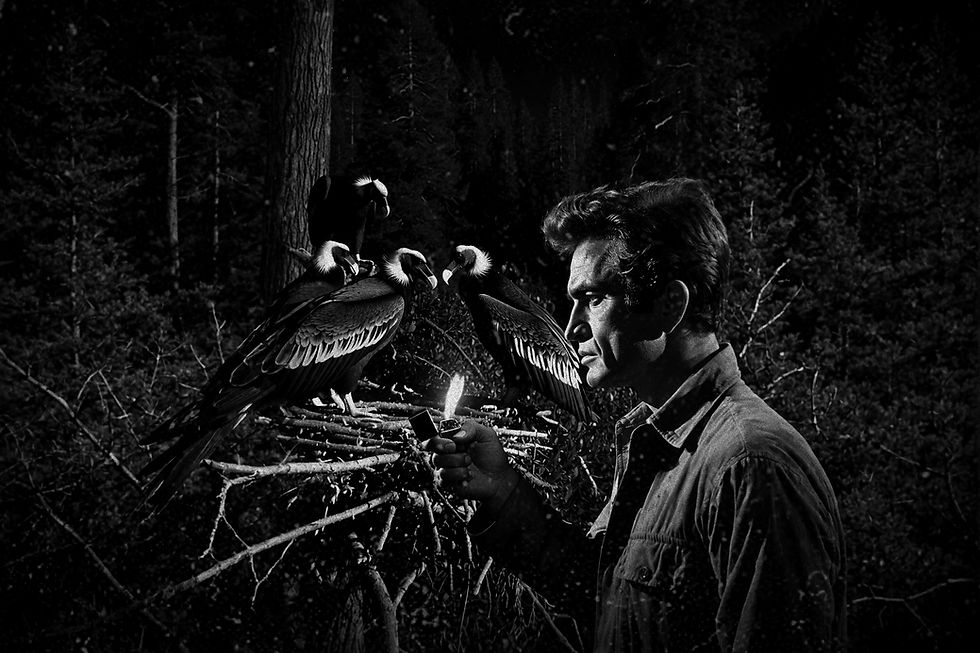
And now imagine your name is Johnny Cash and you recount in your autobiography:
Investigator: “Did you start this fire?”
Cash: “No, my truck did, and it’s dead, so you can’t question it.”
Investigator: “Do you feel bad about what you did?”
Cash: “Well, I feel pretty good right now.”
Investigator: “But how about driving all those condors out of the refuge?”
Cash: “You mean those big yellow buzzards?”
Investigator: “Yes, Mr. Cash, those yellow buzzards.”
Cash: “I don’t give a damn about your yellow buzzards. Why should I care?”
Cash would be fined $125,000 (amounting to $1,310,000 today); however this disruption would contribute to the species plummeting to less than two dozen individuals by 1980.
SO NOW?
To save the species, all remaining wild condors were captured. The California Condor Recovery Program, a broad partnership between the feds, states, and tribes, led by the US Fish & Wildlife Service, spent the last four decades raising hundreds of these birds in captivity. The Peregrine Fund, partnered with the LA, Santa Barbra, and San Diego Zoos, have released 300 condors back into California, Baja California, Arizona, and Utah, seeking to establish distinct sustainable populations of at least 150 birds and 15 breeding pairs in each region. After a generation of concerted effort there are 392 free-flying wild California condors today.