MIXED MESSAGING or TURNS OUT WE'RE JUST HUMAN
Updated: Jun 9
I don’t really want to discuss the current conflict in Iran. That’s being beaten to death by the uninformed and by those who’ve only ever failed to make accurate predictions about prior conflicts. Alas. Noting how contradictory the accounting seems has been entertaining, however. And that contradiction comes from every vantage point on nearly every aspect: from what is happening and to whom, why, and what the inevitable outcome will be. Every bit of it seems zany to me.
A perfect anecdote to highlight this is how CNN, of all places, was citing an NBC News poll, of all polls, offering data from a viewer survey suggesting 100% of MAGA continues to approve of Trump and his actions. Of course, I don’t know how any serious poll could land on 100% for any question (“Is the Earth flat?”, “Did we land on the Moon?”, “Does a cabal of interdimensional lizard-people control water fluoridation rates and the price of frozen concentrated orange juice?”); but I’m also not sure how they’re defining “MAGA”, how they control for just those voices, or what “approval” even means… Still, that’s the poll and what’s being shared all over the place.
Simultaneous with this, many Trump backers, folks like Conservative journalists Sohrab Ahmari and Christopher Caldwell but also a vast swathe of the podcaster cohort who most popularly came out in support of MAGA’s dear leader, have been going around declaring that his recent escapades in Venezuela and now in Iran are deeply upsetting and contrary to everything they understood him and all those aligned to him said they were about. They do this as if they knew nothing about the man, haven’t been paying any attention for decades, and didn’t go back and look at any of his prior proclamations at any point, either. Ahmari effectively blames Democrats, telling us “...Trump the war-wary populist has now fully given way to his liberal caricature: venal, erratic, childish, a chaos agent,” and concludes, “He was never the one.” Caldwell finds Trump’s “...attack on Iran is so wildly inconsistent with the wishes of his own base, so diametrically opposed to their reading of the national interest, that it is likely to mark the end of Trumpism as a project.” Wild.
Isn’t all this the narrative double-helix, even coming from sources most alike, so common to many current events? Seems so. What I’d love to know is, even if you voted for Trump and only ever listen to Conservative voices, which of these conflicting reports strikes you as more accurate and where America, the Conservative coalition, or merely MAGA will be a year from now? And if you have an answer to that, to whom are you listening and why? Or are you just running on desire and intuition and taking in none of the above or anything like it?
MIS-ASPIRATION
Thinking about language and the president making America (and Canada, Greenland, Cuba, Venezuela, Iran, and more) great again — with a preference for blasting through geopolitical impasses with B-2 stealth bombers and/or Delta Force’s 160th Special Operations Aviation “Nightstalker” Regiment — I got thinking about the “great”.
As you'll recall, at the incarnation of the MAGA movement and again after the election of the real estate/reality show star, discussion of America’s past and how good or horrendous it may have been was addressed ad nauseum. That was warranted but too often poorly executed. It usually came in the form of the ahistorical bleatings and bawlings of those who neither lived through relevant periods nor showed any signs of knowing anything about them. So often they wouldn't even talk to anyone self-describing with the label MAGA. From my perspective, nothing could be more tiresome or pointless.
What folks who had anything positive to say about the country or its past seemed to agree upon was that America and those who built and sustained her were once amazing and are now proving to be less so, or at least gone off track. The diagnoses for the decline were abundant. Many noted how in living memory Americans were far better at family, work, and “building stuff.” Folks recalled how Americans used to be great neighbours (or at minimum know their neighbours) and could reliably be considered enthusiastic patriots. To make this argument, many would harken back to those people, the population coined by Tom Brokaw in his book by the same name, we know as “The Greatest Generation”, who participated in and lived through the Second World War.
Those were the people who crushed fascism, freed and made the world safe; and when they returned home, they bought or built a house, had themselves a nuclear family, and just worked really damn hard, prospering as a result. Trouble is, that story didn't come about by the autobiographical account of those folks or by being uncovered in polling data but largely as fictional tales told much later (commonly concocted by sons who adored their warrior fathers) and as a result the popular conception is one that falls rather far from comporting with any version of the historical record.
HOW TO DEHUMANIZE A WHOLE POPULATION
We’re told this generation of people were just more robust and competent than others, hence the title. We say this knowing that somewhere on the order of 50 million men registered for the draft and only around 10 million were inducted, as the majority were disqualified or served in non-combat roles. In fact, 6.5 million American men (about 43% of all those evaluated for service) were deemed “4-F: unfit for military duty." Why? For all the reasons you’d expect: due to physical, cognitive, psychological, or “moral” concerns, rendering them unsuitable — even to fill a boat as certain fodder on a French beach for D-Day. That’s rather unfit, indeed, and, if only to me, doesn’t paint this generation as super-human.
Too, many thousands of those men kept out of service, almost certainly some of America’s best war fighters, were restricted as the military at this time classified homosexuality as a “psychopathic personality disorder”. Many more, of course, had also, apparently, committed the crime of being Black and were rejected on those grounds alone. Imagine a nation under such a threat so thoroughly shooting itself in its foot (and its strong hand… and then in the face, for good measure…) And imagine portraying for all future generations in virtually every fictional and non-fictional account since then that the war was an existential emergency demanding the efforts of everyone. It was "total war" [minus half the male population, including thousands upon thousands of fit and willing volunteers]!
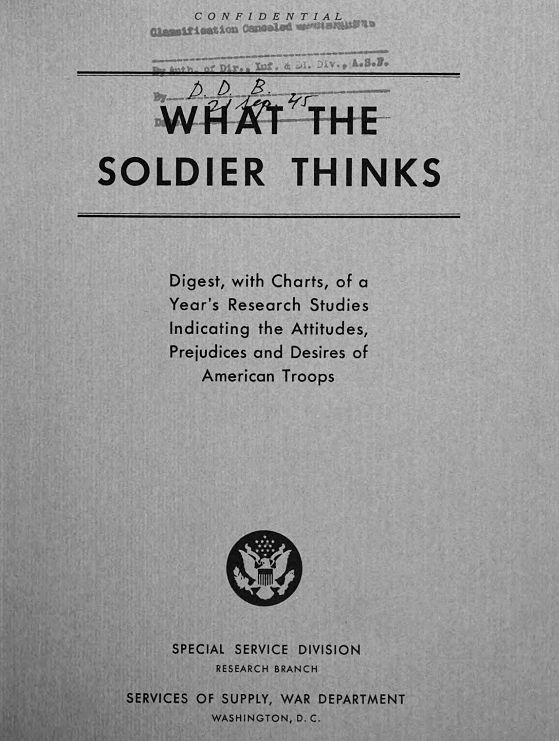
In this context, the US military administered a variety of surveys to over half a million troops as the war unfolded, usually a few thousand at a time in specific units or theatres of war, seeking to learn about their motivations, their experience, and what they thought of the conflict. The anonymized results were recently revealed, 65,000 pages of them, and made public by a historian working in the National Archives. If you choose to read those results, a unique glimpse into the minds of men at war in their own words, there are many glimmers of hope and beauty but it’s all too human and the worst of it is pretty terrible. It exposes how offensive the title of “the greatest generation” is to that cohort, who, like the rest of us, were just making do with the tools they had in the circumstances they found themselves thrust, largely against their will.
My takeaway from reading a whole lot of what's available is how so much of the opinion and perspective, from folks born a century ago in what everyone agrees was a staggeringly different time than our own, appears no different than I imagine you would get from a similar survey of such a broad swathe of American society today — particularly the persistent complaining. They whinge about everything from the amount and quality of the food to there not being enough books available or enough time to write letters; they moan about the work they’re doing and/or not being allowed to do and the amount of work. Most common is the sentiment that they would be doing more for the cause if they were home on the farm… These are our selfless heroes. Doubtless my surprise at reading all that is almost entirely due to our unrelenting enthusiasm for lying about this time and the people who lived it and doing so across all media and for generations now.
No different from what I hear from folks who spent time in Iraq or Afghanistan, these soldiers did not have strong feelings about allied or enemy nations or the civilian populations therein. Even after the war in Europe was over, for instance, about half of the fighting men surveyed expressed no strong feelings against the German public who, like their families at home, comprised so much of the war machine, busily manufacturing the ships, tanks, and planes and the ammunition chewing through all their friends. More than that, almost 30% reported having no feelings even about the Nazis they were blowing up or in the crosshairs of. They were even sympathetic to their enemy's situation, reporting feeling they were “like us” and only doing what their country called upon them to do. Soldiers did not appear to think very highly of their European allies, however, expressing their concern that with the immediate threat at home extinguished they would likely fail to reciprocate America’s efforts against German aggression and provide no aid in the battle against the Japanese. Too, again to my surprise, those serving in battle also tended to express much disdain for those at home who are not, even those they knew were deemed unfit.
Even when the conflict was weeks from ending, this sort of pessimism was abundant and there was a predominant fear that the war was likely to drag on for years and, as war does, consume tremendous volumes of souls and supplies. In a survey from June of 1945 (the attack on Pearl Harbor came in December of ‘41, the war in Europe ended in May of ‘45, and the bomb would be dropped in August of ‘45), almost 70% of enlisted men surveyed responded to the question “How do you size up the war ahead in the Pacific - have we already done most of the job or do we still have the hardest part of the job ahead of us?” with “We still have to face a hard struggle in which America will suffer great losses in men and materials.” And 60% tell their superiors that they feel the war is not worth fighting. (How much more essential does that make the positive test results at Trinity Site seem?!)
Given soldiers’ reported wellbeing, that pessimism likely made sense. Aside from the majority of respondents reporting no noble cause or aims but being there only because they were conscripted, most report having trouble sleeping, suffering nervousness and anxiety, being regularly worried or upset, and experiencing many physiological effects such as unexplained tremors and sweating. Of course, not wanting to be there, doing poorly physically or mentally, and facing down what you imagine will be years of hardship on the battlefield almost inevitably results in incredibly high rates of desertion and suicide. As I understand, that was a situation with all Allied troops.
That reality is paired with other surprising findings, ones you’ve probably heard before, such as that three out of four soldiers in combat did not shoot their weapons. This finding was reported by war historians as early as 1947 and was considered trustworthy for decades but is disputed though not disconfirmed today. Even on D-Day at Omaha Beach, it is said that of the ten companies present only five were deemed effective, and within those companies only about 20% of soldiers fired a single round at the enemy at any point. It's hard to tell if that is actually true. But even if they disagree on how common it is, military experts do tend to agree about why soldiers don't fire. Typically it is not a philosophically- or spiritually-motivated refusal to do harm but one or a combination of being suppressed by heavy fire, the disorienting chaos of battle, or an understandable paralyzing fear that can strike even those well-trained.
If that’s how troops felt about the war, their allies, and themselves, what do you think they thought of their co-conscripts? Some are asked about race and racial segregation in the military and express highly cosmopolitan views, both about how the military should be organized and run and also about how they hope equality will reign at home and around the world after the war. Others are… well, less eager to see change. For example, a soldier who’d completed his survey landed on the concluding question asking if he had any additional remarks he wanted authorities to be aware of. He did, indeed. He spells out how “White supremacy must be maintained” and that “I’ll fight if necessary to prevent racial equality.” He goes on and concludes that “Segregation of the races must continue.” And, of course, Black conscripts encountered this sort of thing in training and on deployment and wonder in ink things like whether or not their fellow soldiers, “crackers”, are aware that the Civil War has been over for some time. Still other men wonder about if there is such a clear distinction between Germany under Hitler and the US under Roosevelt. One man asks:
Why do I as a Negro wear the uniform and fight the Germans because of things that they have done and the same things are being done my own people here in this Country. The Germans deny a minority group the privileges of working at profitable jobs + permit them only the most menial. In Democratic America the same thing exist. In Germany the franchise is denied or restricted. In the representative democracy of the U.S. the same condition exists. Therefore it would appear that my country is guilty of the same things she attempts to punish another for.
This calls to mind some famous letters from Canadians to their government as their lands and belongings were being confiscated and they and their families interned in remote camps. The resemblance is perhaps not so surprising.
I won’t wait for Tom Hanks to star in the Hollywood film about any of this but folks are writing about it. Many other sentiments, habits, and outcomes reveal themselves in the survey data and can also be found well-researched in works such as the fantastic Myth and the Greatest Generation: A Social History of Americans in WWII, by Kenneth Rose. Everyone should read this book. Prior to this and similar work I’d never considered so much of what is found there. Things like: how the military supplied troops with a cigarette ration. The consequence of that was that the rate of male smoking in the US went from around 30% prior to the war to above 70% after, seemingly turning America into a nation of smokers. That’s wild. Without the war it seems unlikely smoking would have taken over as it did nor, as a result, become such a cultural signifier in film and television as still seen today. Crazy. Or, I didn’t realize the level of labor unrest common at the time. Somehow I imagined everyone was more or less on the same page and, of course, everyone was just pressing ahead, making all the sacrifices needed to win the war. Nothing could be further from the truth. Even within critical war-production industries, absenteeism ran as high as 20%. And it turns out some 14,471 strikes were recorded over just the few years of this war and despite official pledges from unions that they would not strike. In the troop surveys soldiers, receiving letters from home and eagerly reading the news, complain about the impact of the strikes on their supply chains and morale, feeling like folks in the US, whether bosses or labourers, are being selfish and don't want them to win the war. Wild.
Just as interesting to me, given how we mythologize this population, is just how significant both sex and infidelity was for this generation. We all know the earned stereotypes about young men at war but the numbers are pretty crazy. With half the nation’s twenty-something males far from home and with plenty of downtime, to deal with the rampant STIs plaguing the military and impacting their operational readiness, authorities were shipping an equivalent of … wait for it … 50,000 condoms per day to the front lines. Troop surveys from the Asia theatre (China/India/Burma) in 1944 revealed more than 50% of soldiers reporting having sex with locals. Similar questioning a year later from Europe, in Italy (where something like 350,000 US men were stationed at some point), showed only 20% of soldiers having no sex over a three month period. And of the other 80%, a significant majority reported paying for sex and doing so effectively at every opportunity.
Though many of us know that this was the era of the “Dear John” letter, few are as aware that there was a trade among service men in nude photos, not for more obvious purposes but to have something they could psychologically wound their now-former girlfriend or spouse with when their almost-inevitable letter arrived. Brutal. With all of this, not only did wartime America see a doubling of divorce rates to the highest ever in 1945-46 but mass abortions and mass child abandonment became rampant, too. San Francisco’s District Attorney, Edmund G. Brown explained, for example, as reported in The New York Times in January of 1946, that the city saw far fewer births than abortions in the previous year (abortion, of course, being still firmly illegal and highly taboo in California at the time.) And it’s hard to imagine other major port cities experienced a dramatically different situation.
All in all, this sort of thing is the picture, the majority of what was going on, so completely excised when we dehumanize these people, transmuting them into heroes and saints. Turns out they were just people. And is there any doubt that such omissions and deletions leave us with a blindness and ignorance that gets us into all kinds of trouble today? I’d be alarmed to learn that it didn’t. If it is this myth to which you seek to compare present generations or yourself to or, worse, aspire toward, as I see it, you can only condemn us all. Doubtless.
FOR MORE SEE:
Culpepper, 2008
Childers, 2009
Bérubé, 2010