TEN BILLION TO ONE or BISON³ REDUX
Updated: Jul 10
Back in 2019 I wrote about bison. I noticed that the numbers and circumstances commonly offered relating to the historic abundance and eventual disappearance of this species, who at one time thrived across nearly the whole continent but were rapidly reduced to almost zero, made little sense.
If you’ve never come across it, the usual version of events deviates little from what is found on the US National Park Service website:
Bison herds in the western United States were so massive, they shook the ground and sounded like thunder in the distance. The American bison roamed most of North America and in the early 19th century, population estimates were between 30 million to 60 million. … By the late 1880s, the endless herds of bison were wiped out and just a few hundred individuals remained.
The cause of the population decline is commonly spelled out by authoritative sources who, just as you would hope and expect, have evaluated all the available historical evidence and the modern research based on that. As the story goes, just as found in this IUCN report from their American Bison Specialist Group, with dozens of expert contributors from across the continent, the cause of the bison decline is said to be multivariate, but:
Commercial hunting by Euroamericans and some Native North Americans for meat and hides was a primary cause (Hornaday 1889; Isenberg 2000). The American military quietly approved illicit market hunting on federally protected tribal lands in the northern and southern plains. Other factors included indiscriminate slaughter for sport and recreation. Sport hunting was exacerbated by the westward push of colonization from the east and across the prairies with the implicit and explicit approval of politicians and military leaders anxious to resolve the food supply side of the so-called “Indian problem.” (Danz 1997; Dary 1989; Hewitt 1919; Isenberg 2000; McHugh 1972.)
I'd seen and heard this sort of thing a million times and had no reason to disagree with any part of the story. But I'd also never really thought about the situation, the species we’re talking about, the logistics for such a massive project, and the circumstances on the ground. So I did that. This was just a thought experiment one afternoon while sitting in my dorm room and just using the numbers most folks like to offer.
I could think up all kinds of scenarios to get this terrible deed done or even circumstances to see it happen without human intervention but most certainly not with the numbers and variables so popularly presented. It seemed to me that tens of millions of bison could not be shot in just a few years as described or that, as most tellings report, only their skins were taken (or even that this was true most of the time, in tens of millions of instances.)
The most basic problem was that people appear desperate, for some reason, to frame this as an even bigger catastrophe. In their minds, near-extinction wasn't the problem so much as the number of animals who died, or something. With this calculus, they favour very high numbers, like 60 million or more. And they do this without considering any of what that entails on the biology side or in terms of the hunt. If you have conversations about this or seek out YouTube videos or podcasts from experts, or merely sources moderately informed on the matter, you’ll discover an eagerness to offer bison population estimates twice that or more of what could ever be presented for peer-review. And with that there's no shortage of people and institutions thrilled to share such offerings as fact to the wider world.
For example, the celebrated scholar Wade Davis recently had published in The Narwal and in The Tyee, really anywhere that would take him, an essay he penned as a contribution to a new book (offered by UBC’s Peter Wall Institute for Advanced Studies). In it Davis tells readers that “over 100 million bison were slaughtered.” Similarly, a recent art installation for Toronto’s Luminato Festival, by Anishinaabe artist Jay Soule, titled “Built on Genocide”, presented the public a towering pile of bison skulls. The exhibit explains to visitors and the press that “They say at the time of European contact, there was anywhere from 60 to 100 million bison that roamed North America...” Texas Parks and Wildlife also provides the public with a similar number, telling us that “By the late 1800s, vast herds of 100 million bison and 40 million pronghorn antelope pounding across the American plains had vanished.” You see, this hallucinatory inflation can be found almost everywhere, from all sources, and in every form, not arriving two centuries ago as rumour in overseas tabloids but at present from those who should be leading sources on this continent.
And if any accounts pair peak historic population figures with any other information, which is rare, they tend to suggest this terrible slaughter that took place in the early 1870s saw annual kills of up to one or perhaps as many as two million bison. There are no higher figures based on any evidence or even any inferred from anecdote. Noticing this, I reasoned that, at the very least, those largest numbers for annual hunts (which seemed like weak guesses based on an absence of information) probably would not have come close to the number of new calves born each year by such a huge population of just 60 million, or even half that number. And I proposed that any annual cull taking a single or low double digit percentage (especially with a diverse scattering of many herds spread across the whole continent) very much would not in itself threaten the species with endangerment, never mind bringing bison everywhere to near-extinction. That made the whole narrative messy and feel like the common version of events was pretty unlikely. But that was just the start.

Traditional bison range
Beyond the basic population and harvest/extermination numbers, I also didn’t like the obvious problem of there being so many millions of animals spread across the bulk of North America, from Alaska to Florida and most places in between, and so few humans with no way to easily penetrate remote areas (which was most of the continent back in the mid and late 1800s). Accompanying that, and critical here, is what this maximal bison population disbursal tells us about these organisms. It seemed to me that any animal known to thrive in the dry scrubland and rugged mountains of Northern Mexico and Southern Texas (think Big Bend National Park) and in the steamy Gulf states, but also in the continent’s vast grasslands through to the transition zones between northern Boreal wetlands and Arctic tundra of Northern Canada and Alaska (check out Wood Buffalo National Park or the Innoko or Yukon Flats National Wildlife Refuges) is not a fragile animal clinging to a narrow and easily disrupted niche common of so many threatened or endangered species. As modern recovery efforts have shown, bison can make a go of it almost anywhere they find themselves and almost anywhere you try to stick ‘em — from Catalina Island to the Grand Canyon to Banff National Park and the marshlands and floodplains of Western Alaska. I'd even heard stories about how in the 1920s someone relocated two dozen plains bison from Montana up to Alaska, and who thrived up there and whose descendants now number almost 1,000 today.
In stark contrast to bison, there are loads of organisms living in this same territory whose total known range is just one cave, pond, or set of thermal springs, or just one island, stretch of coastline, or set of Arctic meadows. Check out the:
White Pine Amphipod (Stygobromus albapinus)
A freshwater shrimp occupying one cave in Nevada's Snake Range.
Banff Springs Snail (Physella johnsoni)
A snail living only in the thermal mineral waters in Banff National Park, Alberta.
Island Scrub-Jay (Aphelocoma insularis)
A bird species confined to Santa Cruz Island, off the coast of California.
Yukon Draba (Draba yukonensis)
A wee plant found occupying less than 5km² of meadows in southwestern Yukon.
Along with that, no one wished to explain how, once tracked down, folks were getting at those millions of bison (renowned for their keen sense of hearing and smell as well as their speed and agility, able to quickly hit 35mph and leap high fences, while also being highly capable swimmers.) The bulk of the continent remained open terrain during this time, not crisscrossed by train tracks or highways, or impeded by massive culverts or dams, or vast stretches of fencing. In fact, barbed wire was not invented, mass produced, or deployed before the bison hunt was effectively over. Major ranching areas, such as the Texas Panhandle, didn’t see large enclosures until the mid 1880s — which was not enthusiastically taken up but actually caused tremendous push-back from open-range herders, hunters, and lovers of wildlife, resulting in the "Fence-Cutting Wars." And, even then, typical cattle fencing is not the sort of thing that can keep bison penned. Current publications on keeping bison tend to be adamant that, whether barbed or highly electrified, six or eight feet high, "NO fence design will contain a bison that does not want to stay in that fence."

"Settlers taking the law in their own hands cutting 15 miles of the Brighton Ranch fence in 1885" - S.D. Butcher
Given that bison were free to roam and flee across a largely uninterrupted land of many millions of square kilometres, how was an army or just an individual riding up to a million skittish bison on horseback and blasting away at them with extraordinarily loud, highly visual rounds (not with modern smokeless ammunition but with a boom, flash, and plume of smoke billowing with every shot) with their slow-firing rifles and without causing a stampede? How would someone pull off shooting dozens, hundreds, or thousands of bison from hiding even from the maximum range of their rifle, whose rounds had to be lobbed in a rainbow arch at almost any distance? And didn't all this have to happen without sending up a feathered and furry alarm of all the fauna for miles around (bobcats and coyotes, deer, bighorn sheep, and pronghorn, grouse, turkeys, and hawks, squirrels, jackrabbits, prairie-dogs, porcupines, and more)? This seemed to me, a non-hunter, like an near-impossible task.
Of course, no one volunteered where the, what, three, five, or twenty-five million rounds of .45 or .50 caliber rifle ammunition came from for just one hunting season, who paid for that, or how it was moved and stored. (I found accounts from the 19th century talking about one or two shots per kill being possible with a "buffalo gun" but also folks hunting bison and having to put almost ten or even twenty lower caliber rifle rounds, such as those used in repeating rifles, into a large bison before it was dead.) Even if all of these bullets were just surplus from the Civil War and the federal government was covering the cost, all of it still had to get from the factories and arsenals out East to the remotest parts of the Old West. And those would have been packaged and moved in bulky wooden crates (and likely disbursed for safety.) As far as I could tell, all of that was not a few boxes of bullets but something like hundreds of metric tons-worth, maybe 400 tons or more, making this event closer to the scale of a war than a large hunting trip. Again this is one hunting season. There were at least three such seasons and some smaller ones, too. Now you’re at 1,200-1,500 tons or something. At minimum that tonnage had to be moved and stored somewhere (last time I checked lead and black powder doesn’t grow in the grasslands of Kansas or South Dakota) and you can expect good accounting of that not a total mystery.
All of this and we were still not yet talking about each hunter needing a team of men and horses, a wagon or two, camping gear and supplies for four to six months, typically over winter… All of that seemed like a real problem and yet that was just what I thought of as the input side of things, just the hunting bit, but every bit of it was being treated like irrelevant externalities.
I also wanted to know how all of these valuable resources, the meat and bones, were just left behind, as so commonly insisted. You can find this assertion in all manner of authoritative source including Indigenous encyclopedias (where it is explained that "Non-Indigenous hunters used repeating rifles to kill countless bison for their hides, leaving the carcasses behind to rot") or in university education guides, even from institutions in bison territory (telling us "Settlers sold buffalo hides for $3.50 but strictly only the hides. The meat was too costly to transport and sell, so the carcasses were left to rot.") These tales abound despite everyone agreeing that nearly all of the US population, and certainly those in remote parts west of the Mississippi River and doing this work, was living a subsistence lifestyle and/or in abject poverty. So the idea seemed absurd on its face, and only more so if you acknowledged those folks were already committing the time, resources, and labour to find, kill, and skin these animals.
For a real sense of who and where we’re talking about go check out the amazing photos from Solomon Butcher. He was working throughout bison territory, in places like rural Nebraska (though his images are from the late 1880s onward, long after the bison hunt). These are the people who we’re (not) told just left mountains of valuable resources behind.
Images from the S.D.Butcher gallery found at the Nebraska State Historical Society
Consider it for only a moment. Pretend just a fraction of the suggested total bison were shot and killed, just ten million bison, say; and then imagine you’re only talking about up to a thousand pounds of resources per adult bison (males can reach twice that weight). If you could hardly fetch any price for any of that you’re still talking on the order of ten billion (yes, with a ‘B’) pounds of meat and bone. Even if you spread most of that killing over five to ten years you’re talking at least a billion pounds of bison annually. But people will tell you the kill was five or even ten times that size, conducted in half the time, AND that all those resources were not worth anyone’s time and just left to rot. Go look at Butcher’s photos. Look those people in the eyes and tell me they were uninterested in a billion pounds, maybe fifty billion pounds, of raw goods (that they, like Native Americans, could sell but also make into everything from soap and cosmetics to lubricants, needles and awls to pouches and containers, straps, belts, shoes and other clothing, cups, ladles, jewelry, and more… or just collect to feed their cats, dogs, and/or pigs…) Right.
Much weirder still, folks talking about the extermination also like to help visualize this horror by showing images of tremendous piles of bison bones, not scattered as they fell on the open range but gathered, at great expenditures of time and energy, in piles along the train tracks or in a factory lot… make it make sense!
"...taking only their hides."
That none of this was addressed only made all of it seem more like a steaming pile of nonsense. Just to attempt to consider the task of putting bullets in all, most, or merely many of America’s 30 or 60 million bison, I contrasted the bison cull with the US Civil War. That seemed fair as both took place in a similar period with similar timing, locations, resources, technology, and people. But it was the differences that were so critical.
The Civil War lasted four years, from the spring of 1861 to the spring of 1865. The war involved millions of men, perhaps 3.5 million (which would have been about 10% of the total US population at that time.) The most commonly agreed number of deaths is said to be around 620,000. This outcome is estimated to have come about as a result of men firing a combined 1.5 million artillery rounds and something on the order of a billion small arms rounds at one another. They used bayonets, swords, axes and knives; revolvers, rifles, muskets, and early machine guns; grenades, dynamite, land and sea mines, other improvised explosives and all manner of booby traps. They also deployed cannons, artillery, gunships, and even submarines, along with every other tool of death you can think of.

Military men of the time
The peak of the bison hunt, with by far the bulk of the kills, took place in the three years from 1872 through ‘74. Really the only weapon used to kill bison were high-caliber, slow-firing rifles. No one was charging into a herd with a bayonet. Even then it is said the “total railroad shipments to the East between 1872 and 1874 were estimated at 1,378,359 hides.” This figure was less than the total estimate for bison killed in these years and a real total would include the commercial pursuit of hides and subsistence harvesting by locals, making up the “primary cause” of the decline, but also sport hunting and wanton killing, too, which were significant. All of this activity together has been estimated again and again and the highest numbers ever proposed bring the total number of dead bison up to ~3.7 million over the peak of the hunt, or in the vicinity of 1.2 million per year for three years (a number that in no way would reduce the total bison population on the continent if the number of animals was above 10 million.)
It seemed to me like the commitment of people and resources as well as the urgency of the war vastly exceeded that of the bison hunt. It had to have. And yet the argument appears to be that the death visited upon the bison was many times that of the whole-nation Civil War effort — but against animals who were not armed with rifles or squared up against and charging at those hunting them and without the hunters deploying any of the resources or deadliest munitions. Even just one, months-long hunting season in Montana and Kansas alone is said to have produced twice as many kills as the whole four-year-long Civil War! Needless to say, I was skeptical.
BUT THAT WAS THEN
I’ve done a lot more reading about bison and this period since 2019. The most interesting has been delving into all the historical texts commonly cited in this research as well as a pile of newspaper clippings from the time. I also listened to some podcasts and read more about North America’s fur trade, the realities of actual bison hunting, as well as what it takes to process a bison hide. All of it, with many more apparent contradictions, only makes the popular story surrounding the disappearance of the bison even more confounding.
ORIGINAL POPULATION ESTIMATES
Perhaps the most important written record of the bison comes from 1889, in The Extermination of the American Bison by Dr William Hornaday. This author, hunter, zoologist, and primary researcher of bison for the Smithsonian Institute, tells us early on in his book that “Of all the quadrupeds that have lived upon the earth, probably no other species has ever marshaled such innumerable hosts as those of the American bison. It would have been as easy to count or to estimate the number of leaves in a forest as to calculate the number of buffaloes living at any given time during the history of the species previous to 1870.” He also explains of their numbers and range how, though the early pioneers thought bison were abundant in the Atlantic and midwestern states “the herds which lived east of the Mississippi were comparatively only mere stragglers from the innumerable mass which covered the great western pasture region from the Mississippi to the Rocky Mountains, and from the Rio Grande to Great Slave Lake.”
Hornaday collected stories offering specific details about bison encounters. One such story comes from a Colonel Dodge, found in his own work The Plains of the Great West. There we are told of an unbroken mass of animals stretching twenty-five miles wide and fifty miles deep, as well as their predisposition toward freight and stampeding. Dodge writes:
In May, 1871, I drove in a light wagon from Old Fort Zara to Fort Larned, on the Arkansas [along the Santa Fe Trail in central Kansas], 34 miles. At least 25 miles of this distance was through one immense herd, composed of countless smaller herds of buffalo then on their journey north. The road ran along the broad level ‘bottom,’ or valley, of the river.
The whole country appeared one great mass of buffalo, moving slowly to the northward; and it was only when actually among them that it could be ascertained that the apparently solid mass was an agglomeration of innumerable small herds, of from fifty to two hundred animals, separated from the surrounding herds by greater or less space, but still separated. The herds in the valley sullenly got out of my way, and, turning, stared stupidly at me, sometimes at only a few yards’ distance. When I had reached a point where the hills were no longer more than a mile from the road, the buffalo on the hills, seeing an unusual object in their rear, turned, stared an instant, then started at full speed directly towards me, stampeding and bringing with them the numberless herds through which they passed, and pouring down upon me all the herds, no longer separated, but one immense compact mass of plunging animals, mad with fright, and as irresistible as an avalanche.
The situation was by no means pleasant. Reining up my horse (which was fortunately a quiet old beast that had been in at the death of many a buffalo, so that their wildest, maddest rush only caused him to cock his ears in wonder at their unnecessary excitement), I waited until the front of the mass was within 50 yards, when a few well-directed shots from my rifle split the herd, and sent it pouring off in two streams to my right and left. When all had passed me they stopped, apparently perfectly satisfied, though thousands were yet within reach of my rifle and many within less than 100 yards. Disdaining to fire again, I sent my servant to cut out the tongues of the fallen. This occurred so frequently within the next 10 miles, that when I arrived at Fort Larned I had twenty-six tongues in my wagon, representing the greatest number of buffalo that my conscience can reproach me for having murdered on any single day. I was not hunting, wanted no meat, and would not voluntarily have fired at these herds. I killed only in self-preservation and fired almost every shot from the wagon.
To my reading the bison stampede was caused not by Dodge's shooting at them but by his mere presence and killing these animals was done reluctantly, for self-preservation — and he, a military man describing his actions in 1871, at the height of the bison hunt, tells us he could never have otherwise justified such violence.
Hornaday also tells of Dodge’s guess for the number of animals he witnessed that day. The estimate came in 1887, in a private correspondence almost two decades after the events described. Dodge felt somewhere in the range of at least 500,000 was a reasonable guess. Hornaday explains that he rejects that figure, however, preferring his own estimate. He tells us that if they were actually as described this single group would have numbered more than four million. Hornaday proposes, too, that his assessment was “more likely to be below the truth than above it.”
Other population estimates come from accounts telling of a General Sheridan who “was under the impression that the western army could significantly reduce the buffalo herds, thereby demoralizing the plains tribes.” To evaluate the feasibility of that terrible task, it is said that in March of 1869 Sheridan had the men under him go away and return with a reliable estimate just for the animals in one southern herd between Fort Supply, Oklahoma and Fort Dodge, Kansas — a known herd said to stretch more than 100 miles wide. Their first serious estimate came back at 10 billion bison. (Yes, you read that right.) Apparently the general scoffed at the astronomical figure and demanded a revision. The men returned with an estimate of just one billion, a number later revised down to something slightly more plausible but still truly astronomical “more than one hundred million.” In David Smits’ The Frontier Army and the Destruction of the Buffalo: 1865-1883, we’re told that it was due to Sheridan’s belief in the veracity of this nine figure estimate, at least one hundred million bison in this one herd alone, that “Sheridan was forced to abandon all hope of using his tiny army to wipe out the animals.”
How does this account fit with any part of anyone’s version of events? Maybe half the US bison population was 100 million animals and from the outset the military deemed the task of killing them unachievable?...
BETTER POPULATION AND HUNT ESTIMATES
Unhappy with others' accounting, the zoologist, Hornaday, put together a more sophisticated evaluation. He investigated the numbers of bison hides shipped by railways, known to keep decent records and also understood as the primary mode of transport for these goods. From the Atchison, Topeka and Santa Fe Railroad (which only stretched across Kansas and into Colorado at this time), he noted precise figures from the height of the commercial bison hide hunt and extermination period, 1872-74. The company reported moving hides numbering:
165,721 in 1872
251,443 in 1873
42,289 in 1874
But this was just one railroad. With no records for the Union Pacific Railroad (the first US transcontinental railroad, at this time stretching just from Nebraska to Wyoming and into Utah) or the Kansas Pacific Railroad (a more southern route to the Santa Fe, going from Kansas to Colorado), Hornaday just tripled the number to arrive at a total of 1.38 million hides. He also considered there was likely a significant difference between the hides shipped and the actual numbers of animals killed. As such, he presumed the total kills were closer to 3.1 million for the period between ‘72 and ‘74. Hornaday also made the effort to estimate how many bison were killed annually by locals, both Indigenous and new settlers moving out West, for subsistence as well as for the sale of their hides. His total for all the animals killed over three years on the southern plains came in at around 3.7 million (or 1.23 million annually.)
Elsewhere Hornaday estimates that by 1880 there were still more than a million bison residing down south and at least a million in the north of the country, citing reports of “over 500,000” animals near Miles City, Montana. He describes the Northern Pacific Railway facilitating the northern hunt and tells of “75,000 dry/untanned hides” going down the Missouri River in 1881 for export from Bismarck, North Dakota. The zoologist suggests the northern hunt peaked with what he considers heavy shipments of hides, 100,000 in both 1881 and ‘82, and also tells us the bulk of the northern hunt was over in 1883.
Not until the 20th century did anyone consider the carrying capacity of the land, how many animals might reasonably live on the natural productivity of the forage within bison territory. In 1910 and again in 1929, a census of all the livestock on America’s plains was attempted. The math was spelled out at that time by Ernest Thompson Seton (British-born, Canadian-American author, wildlife artist, and pioneer of the Boy Scouts.) In a section on bison found in the third volume of Seton’s acclaimed work The Lives of Game Animals, the author offers that there were roughly 24 million cows and horses and six million sheep surviving on just half the historical range of America’s plains bison. This generous estimate provided for a conservative historic bison population estimate of roughly 45-65 million; but also with Seton’s strong suggestion that the figure was likely not less than 60 million and maybe could have even reached 75 million. Over the century that followed Seton’s work his guess was effectively unchallenged and remains roughly the general consensus today, almost always cited as 30-60 million. Whatever folks are willing to say, our current understanding of plant and animal biology doesn't really permit numbers as high as 75 or 100 million. Still, missing entirely from these estimates, and severely impacting the accuracy and validity for a "total" population figure, is, of course, any data on the historic bison range north of the 49th parallel.
All the first-hand accounts from this same time period up here in Canada sound identical to those down south. Working for the Hudson’s Bay Company, Isaac Cowie was travelling through Saskatchewan in 1869 and reported, “We fell in with buffalo innumerable.” He tells us, “They blackened the whole country, the compact moving masses covering it so that not a glimpse of green grass could be seen. The earth trembled day and night, as they moved in billow-like battalions over the undulations of the plain.” That doesn't sound so different from the 500,000 Dodge wrote of (or four million if you prefer Hornaday's number.) So just ignoring these populations seems weird and can only result in a serious underestimation of any possible total bison population across their known range, a landscape with no meaningful barriers other than the Rocky Mountains and Great Lakes. If Idaho, Wyoming, and South Dakota comprise suitable range for tremendous numbers of plains bison, some tens of millions, then so too was an area the size of five or ten midwestern states making up only territory ideal for bison within the provinces of Manitoba, Saskatchewan, Alberta, and northeastern British Columbia. And this says nothing of a land mass as big again from central Manitoba, across the vast swathe of Boreal forest, ideal wood bison territory, and throughout Alaska where both plains and wood bison are said to have roamed (and currently reside on public and private land and in local and national parks and wildlife refuges.)
That is a bit of a conundrum. If you have to add 50% or 150% to the US estimates for a realistic continental total (perhaps as Wade Davis and friends would like to do) you still have to contend with what that number would mean; and it's not just more deaths but, at minimum, more births as well.
SUSTAINABLE YIELD?
There’s an episode of the podcast Canadian History Ehx on this topic, under the title The Decline of the Bison. The podcast’s website offers an essay to accompany the episode. It explains how, “Reverend John McDougall stated that he estimated herds were half a million when he saw them in Manitoba in 1873. In 1875, a police officer travelling from Fort MacLeod to Fort Qu’Appelle [more than 700km across most of Alberta and Saskatchewan] claimed he was never out of sight of the herds. But by 1880, they were gone.” With this we’re also told that, “The sheer amount of export of bison products was staggering. In 1873, 50,000 buffalo robes were shipped out of Canada alone. From this point, as herds began to get smaller, 30,000 robes were shipped out in 1877, 12,797 in 1878 and 5,764 in 1879.”
Okay, let’s go with that. To begin with, “sustainable yield” refers to the harvest rate permissible to safely maintain a population of any species and applies to cedar on your tree lot or trout in the river. For large herbivores like elk, moose, caribou, or bison, who live 20-25 years, produce around one calf per year, and whose numbers are near the carrying capacity of the land, the annual sustainable yield is typically understood to be 10-20% of the total population. Of course the number differs a bit by species and particular populations due to their different birth rates, depending on whether they're captive or wild, with the quality of the habitat in a given area, and with shifting circumstances such as severe weather events or outbreaks of illness, obviously. However, bison having bounced back to roughly 400,000 animals in North America today, according to America’s National Bison Association these creatures are now sustainably harvested at around 20% per year, with 80,000 being killed in 2023, for instance.
So if, as above, there were just 500,000 bison in all of Canada in 1873, not in just one herd or one province but everywhere (which seems unlikely and far too low), and 50,000 were killed for their hides, as quoted above, this may seem a staggering amount of death if their carcasses were stacked in a pile in front of you but, in reality, would amount to something like the lowest, most conservative end of what we would consider a sustainable yield. Even taking 100,000 a year, 20%, for several years would only be at the high end of a “sustainable harvest” for this species and something unlikely to cause them to disappear from view, never mind go extinct. What am I missing? Where are the missing tens of thousands (or hundreds of thousands or possibly millions) of bison carcasses and hides required just to cause a decline in the population, not virtual extinction?
Zooming out from the Canadian Prairies then, if the North American total was in the 60 million range then this species would have seen an annual birth rate of approximately 12-15 million calves. And if the largest number of bison killed in a year is estimated at roughly 1.2 million then we're saying not even close to 3% of the total population was killed. We also know that highest rate of kills was only sustained for about three years. If the real annual rate was three times as high and lasted a whole decade or even two decades the situation would seem no more severe. But, by all accounts, only a couple other years outside of the peak saw numbers even half as high while most annual estimates suggest nowhere near this number but maybe at or below 100,000.
At the time, publications such as the Chicago Daily Tribune, for example, told of a annual hide collection during the critical period of the early 1870s reaching “more than 100,000 per annum.” That’s 0.16% of 60 million or 0.33% of 30 million. At the same time the Pittsburgh Commercial claimed “A quarter of a million bisons are annually destroyed on the plains.” That's not hides collected but total animals killed. So, still just 0.4% or 0.8%, and nowhere close to just 4%, never mind the sustainable yield standard of 10-20%.
The overwhelming majority of accounts from this period that I can find talk in numbers like this, in the low hundreds of thousands not in the millions per season during the worst of the mass slaughter. And in modern times no one anywhere can point to anything suggesting an annual kill count reached just 5% of the current favoured population estimates, never mind going far beyond a sustainable harvest and hitting 30%, even just in a single year. And, of course, if your preference is for a total population of 75 or 100 million or a billion, like so many, you have to explain how (with known physics and in the absence of nuclear weapons) humans killed in excess of 15-20 million (or, what, 200 million?) bison — not total but per annum!
Too, coming from a communication background it is difficult to avoid mentioning how bad the newspapers of the time were, particularly in the US. Newspapermen were not unlike the theoretical geographers of past centuries, who would invent fraudulent academic papers and present fictitious cartographs before Academies of Science, convincing authorities to send entire navies to risk their ships and souls on voyages across the world to find, for instance, a marine passage connecting the Pacific and Atlantic. These myths occupied the minds of peasants and sailors, men of letters and monarchs alike and as such diverted tremendous resources, wasting countless lives and immeasurable time. The newspapers in the 19th century had yet to establish what came to be thought of as basic journalistic ethics. They were known to fabricate sensational violence and scandal, wild headlines and make-believe interviews all paired with ludicrous illustrations just to sell papers. (Yes, even worse than today.) This phenomenon, what became known as ‘yellow journalism’, the original ‘fake news’, was even newspaper policy, actively pushed by serious publication owners like Hearst and Pulitzer in the last decades of the 19th century. This sets the bison hunt right in the middle of this notorious period of mendacity and mythmaking. That doesn't compel me to want to believe the numbers papers offered at this time. I certainly would not entertain that their figures are underestimates without much more compelling evidence. Appreciating this context certainly muddies everything and is essential to trying to understand what took place.
Regardless, pretend all the population guesses are way off and there were only ever at most 20 million bison on the continent. If you more than double the highest annual kill counts, going all the way to 2.5 million shot, you’ve only reached a low-end of a sustainable yield at 12.5%. If the population was this low and even if disease and/or drought and unusually severe coldsnaps hit several regions of the continent and multiple herds year after year, or several populations inexplicably stopped reproducing entirely, with harvest numbers as low as suggested I don’t see how the result would be the species being wiped clean from the entire continent. But, of course, no one ever talks of a decade of particularly harsh winters or grass refusing to grow. 1815 was the Mount Tambora eruption and 1816 was, consequently, "the year without a summer." And drought is normal in America's Great Plains but the worst during this period was from 1845 to 1856, that certainly would have reduced population numbers but was two decades prior to the bison hunt and long before the massive population counts we have on record and previously noted. So what about disease? Well, with such intimate proximity (seemingly everyone reporting an unending sea of bison between towns from Texas and Oklahoma to Alberta and Saskatchewan), no one reports thousands of sickly animals or their cattle herds picking up strange illnesses as bison herds pass through the area. This is exactly the kind of thing folks would notice and the kinds of rumours that would end up in the local paper, other historical accounts, and certainly modern research, too.
So, for real, where’s the narrative explaining what happened to the other 25, 55, 95, or 195 million bison? Given their numbers and distribution, even if they were abducted by aliens that, I imagine, still would have taken some time and effort as yet unaccounted for and, of course, that would require still more extraordinary evidence.

WHO DUNNIT? AND HOW?
Probably the most confusing thing I found was that the modern accounting of the bison hunt suggests very few men actually took on the task of shooting bison. To this point I imagined many thousands of men, effectively a vast army. However, the concerted side of this effort wasn’t just fewer numbers than those involved in the US Civil War but most histories tell of merely “2,000 active hide-hunters” (or, to contrast with the 10% who fought in the war, just 0.005% of the population) and then only operating during a months-long hunting season. Paired with that, most estimates from the time suggest those fellows all together averaged “5,000 bison per day” or 2.5 bison per man per day at the height of the hunt. That's not “acquired hides” but just “kills.” If real, this would land these hunters 750,000 bison for what is typically said to be the season, lasting about 150 days — a number rather far from the nearly 1.4 million hides Hornaday estimated. Way too low.
At the time, the Decatur Daily Republican noted for the record that hunters “with their Texan reinforcement – two hundred guns in all – will be able to slaughter an average of 500 buffaloes per day.” So not 50-100 daily per man, as many want to pretend. At the end of the last season of the peak hunt period, in the February 1st, 1874 edition of the Daily Nebraska State Journal, they publicly decry the hunt, corroborate this number but cite hides instead of kills. They tell us, “There is no law for the protection of the buffalo. The consequence is that these animals are being slaughtered at such a wholesale rate as will insure their total destruction within a very few years. … That a terrible warfare is being waged against these poor brutes is certain from the fact that one firm on the [Union Pacific] railroad has been shipping their hides at a rate of 500 a day.”
Likewise, in 1887, a General Stewart Van Vliet informed the Smithsonian Institution of his personal kill count of “hundreds.” This is presented as a very large number but the General is talking about a sum over a 20 year period following the end of the Civil War that he, a member of the military, spent in bison country. He is said to be exactly the sort of person focused on this cruel, superhuman campaign to “exterminate” the species. Yet he doesn’t report thousands total or hundreds of kills per year but maybe on the order of, what, 10-20 annually? So General Van Vliet’s lifetime bison count would be a fraction of what others (dubiously) claim a hide-seeker would take in one weekend. Right. So how does that fit into this picture?
The highest harvest rates tend to claim men were capable of killing 15 bison a day and that “at that rate, hunters were killing thirty thousand buffalo per day in one small region.” That said, you can occasionally find people offering far larger numbers. The Smithsonian zoologist, Hornaday, gives us an assessment of the most aggressive shooting to have ever taken place. He tells of the three largest and quickest “bests” he came across. Mr Andrews is said to have shot 115 rounds and killed 63 animals in under an hour. (Notice that even this highest kill count ever sourced says this remarkable effort from a skilled marksman took nearly two rounds per animal.) Another fellow, Mr McNaney, shares a second-hand account of someone shooting 91 bison in one afternoon while the aforementioned Colonel Dodge describes counting 112 downed bison on one day. And it's worth noting that today it is easy to find folks describing the historic slaughter who repeat these largest numbers not as one-off personal bests from a few folks but as standard practice or a realistic count for a typical day's hunt. For instance, a volunteer from the Wyoming State Museum discussing the hunt insists “hunters would kill up to 100 a day.” Could? Sure. Normal? No. But, actually, are any of these highest kill counts possible? I'm not so sure. Why? Well, physics.
It's not jus that the above accounts are at very high risk of being exaggerations for dramatic storytelling effect or self-aggrandizement. (You: “No way! Hunters have never been known to embellish. How dare you!”) I can find historical accounts and modern ones, of hunters and gun enthusiasts deploying old rifles and brand new remakes, describing a typical weapon of this sort needing to be cleaned out after just a handful of shots; of only a few rounds resulting in a barrel overheating and needing to be plunged into water or snow; and of the larger, denser rounds needed to kill a bison with one or two shots, certainly at a hundred rounds an hour, quickly causing a meaningful amount of damage to a barrel’s rifling and impacting the weapon's accuracy (when the very first round of the season already had to be aimed at the clouds to hit an animal just 300 yards away).
I propose that extreme cases of the sort described above represent the maximum destructive potential and maximum efficiency of a hunter on the best outing of their life. Meaning: effectively every other person and every other outing would surely see a far lower number of kills and more shots, two or ten, per kill. In fact, I just watched a podcast on bison recovery in Alaska. A biologist, and hunter, from the local restoration project told a story about local hunter mistaking one of their protected bison for a bear and, shooting from hundreds of yards similar to that described in historic bison hunts but with a new weapon and modern ammunition, taking 10 rounds to finally kill the animal.
One article I found suggested this wholesale killing was so severe that around the end of the peak, after just two serious hunting seasons and not three million animals killed, there were "no buffaloes to be seen on the plains except dead ones." Around the same time, in the fall of 1873, the aforementioned Colonel Dodge described the situation with the southern herd in Kansas, saying “Where there were myriads of buffalo the year before, there were now myriads of carcasses. The air was foul with a sickening stench, and the vast plain, which only a short twelvemonth before teemed with animal life, was a dead, solitary, putrid desert.” Not in 1880 or 1900 but in January of 1874 the Nashville Union ran an article explaining the situation similarly, offering specific numbers (and thus more details posing still more problems):
Mr. Lessing estimates that there are at least two thousand hunters in camp along there waiting for buffalo. He came across one party of sixteen, who stated that they killed twenty-eight thousand buffaloes during the past summer, the hides of which only were utilized. If sixteen hunters can kill this many animals, how great must be the slaughter upon the broad extent of the bison range? Evidently millions of the animals must have been killed during the past summer alone. Mr. Lessing says there are no buffaloes to be seen on the plains except dead ones, and that hunt as much as they may, the sportsmen cannot at present find any game. The value of the hides has deteriorated considerably, owing to a great increase of the article in the market. Heretofore they were worth $3 delivered at the railway stations, while now a distinction is made as to the size, and paid for accordingly, the prices ranging from 4¢ to $1.00 per hide.
Though the above account mentions the summer, most tellings of the bison hunt talk about the season lasting up to five months, typically mid-October to mid-February. I’m told this was because at this time of year the hide was of the highest quality and yielded the best price for hunters. As far as I can tell then, by this account of 28,000 killed, this one small team (not even 1% of the 2,000-man bison-killing army) had to see each man shoot 1,750 bison for the season (around 12 per day or about 80 per week.)
As ever, unexplained is how 16 men fired, what, a collective 200-400 rounds per day — even at a great distance and even if they coordinated their explosive fire to ring out at less than one shot a minute — into a herd of bison without spooking these animals. Could you approach a herd of wild bison on horseback? Could a dozen or more do so together or even far apart? If you found a herd by foot or by horse, and have a rifle with 100 rounds of ammunition, and below you, at 300 yards, was 20,000 or maybe 200,000 bison, how could you only hit two of them over 24hrs, as in most accounts? And if you dropped 10 (or 100), along with two or 200 of your friends, how does all that gunfire and all the collapsing bulls and cows not scatter the herd? And then how does none of the requisite infiltration, skinning, and exfiltration fail to arouse any interest or panic, either? Could you do that even with pacified, domesticated cattle? And then how do you even move ten bison hides without a horse or wagon and all the disturbance inherent in that? (I have questions!) Well, there were some authoritative sources from around this time who spelled some of this out.
Dr Hornaday describes, in his 1889 book, what he says “may fairly be taken as a typical illustration of the life and work of the still-hunter at its best.” Though providing many specifics, it, as ever, poses only more problems as I see it. Hornaday tells us about a Mr McNaney who worked as a hunter around this critical period:
Although at that time only seventeen years of age, [McNaney] took an elder brother as a partner, and purchased an outfit in Miles City, of which the following were the principal items:
Two wagons, 2 four-horse teams, 2 saddle-horses, 2 wall-tents, 1 cook-stove with pipe, 1 40-90 Sharp’s rifle (breech-loading), 1 45-70 Sharps rifle (breech-loading), 1 45-120 Sharps rifle (breech-loading), 50 pounds gunpowder, 550 pounds lead, 4,500 primers, 600 brass shells, 4 sheets patch-paper, 60 Wilson skinning knives, 3 butcher’s steels, 1 portable grindstone, flour, bacon, baking-powder, coffee, sugar, molasses, dried apples, canned vegetables, beans, etc., in quantity.
The entire cost of the outfit was about $1,400. Two men were hired for the season at $50 per month, and the party started from Miles City on November 10, which was considered a very late start. The usual time of setting out for the range was about October 1.
The outfit went by rail northeastward to Terry, and from thence across country south and east about 100 miles, around the head of O’Fallon Creek to the head of Beaver Creek, a tributary of the Little Missouri. A good range was selected, without encroachment upon the domains of the hunters already in the field, and the camp was made near the bank of the creek, close to a supply of wood and water, and screened from distant observation by a circle of hills and ridges. The two rectangular wall-tents were set up end to end, with the cook-stove in the middle, where the ends came together. In one tent the cooking and eating was done, and the other contained the beds.
It was planned that the various members of the party should cook turn about, a week at a time, but one of them soon developed such a rare and conspicuous talent for bread-making and general cookery that he was elected by acclamation to cook during the entire season. To the other three members fell the hunting. Each man hunted separately from the others, and skinned all the animals that his rifle brought down.
There were buffalo on the range when the hunters arrived, and the killing began at once. At daylight the still-hunter sallied forth on foot, carrying in his hand his huge Sharps rifle, weighing from 16 to 19 pounds, with from seventy-five to one hundred loaded cartridges in his two belts or his pockets. At his side, depending from his belt, hung his “hunter’s companion,” a flat leather scabbard, containing a ripping knife, a skinning knife, and a butcher’s steel upon which to sharpen them. The total weight carried was very considerable, seldom less than 36 pounds, and often more.
Inasmuch as it was highly important to move camp as seldom as possible in the course of a season’s work, the hunter exercised the greatest precaution in killing his game, and had ever before his mind the necessity of doing his killing without frightening away the survivors.
With ten thousand buffaloes on their range, it was considered the height of good luck to find a “bunch” of fifty head in a secluded “draw” or hollow, where it was possible to “make a kill” without disturbing the big herd.
The still-hunter usually went on foot, for when buffaloes became so scarce as to make it necessary for him to ride his occupation was practically gone. At the time I speak of, the hunter seldom had to walk more than 3 miles from camp to find buffalo, in case there were any at all on his range, and it was usually an advantage to be without a horse. From the top of a ridge or high butte the country was carefully scanned, and if several small herds were in sight the one easiest to approach was selected as the one to attack. It was far better to find a herd lying down or quietly grazing, or sheltering from a cold wind, than to find it traveling, for while a hard run of a mile or two often enabled the hunter to “head off” a moving herd and kill a certain number of animals out of it, the net results were never half so satisfactory as with herds absolutely at rest.
Having decided upon an attack, the hunter gets to leeward of his game, and approaches it according to the nature of the ground. If it is in a hollow, he secures a position at the top of the nearest ridge, as close as he can get. If it is in a level “flat,” he looks for a gully up which he can skulk until within good rifle-shot. If there is no gully, he may be obliged to crawl half a mile on his hands and knees, often through snow or amongst beds of prickly pear, taking advantage of even such scanty cover as sage-brush affords. Some Montana still-hunters adopted the method of drawing a gunny-sack over the entire upper half of the body, with holes cut for the eyes and arms, which simple but unpicturesque arrangement often enabled the hunter to approach his game much more easily and more closely than would otherwise have been possible.
So, as suspected, a train couldn't get them anywhere near their intended hunting ground. They still had to travel another 100 miles. Once in the territory of a herd it was normal to travel several miles by foot, not on horseback, to get within rifle’s reach of the animals. Why? Because this species is so easily spooked. Obviously. And, to further avoid spooking the herd, one tended use camouflage and/or to sneak up on the animals by crawling on their belly in the dirt, mud, and frost for half a mile or more just to get within the 250-500 yard range afforded by a high-caliber rifle.
Just think about this. For scale, if your walk was, as above, just a straight three miles (almost 5km) in Victoria, BC, that would be from Victoria’s Legislature on the Inner Harbour to Swan Lake, Mount Tolmie, or the Victoria Golf Club in Oak Bay. On the sidewalk in summer, that’s up to two hours walk if you're quick. From Mount Tolmie, say, you’re on your belly crawling all the way to, say, UVic — maybe another hour or even two hours, or half an hour if you’re impatient, risk spooking these beasts, and merely crouch low, walking in a squat for the first half and only on your belly just the last half of the way. So, three to four hours in, once at UVic and within range of some animals now you have to shoot a bison or two (or 15 or 43 or 97). But now notice that’s not really even half the battle.
The common narrative fails to delve into the necessity of skinning, moving, stretching, and drying a million bison hides or even just 150. As in the story from Hornaday, this work is commonly being done by teenagers who are giving it a go one season or maybe a couple consecutive years (just as you find in similar seasonal labour today, like treeplanting or fruit picking) it is not mostly teams of professionals for whom this is all they've ever done. And the facts of the matter are clear. A small bison would be well over 800lbs and a big one being 2,800lbs (the largest coming in at well over 3,000lbs and the record said to be 3,801lbs.) The hide on such an animal would be larger than the comforter on your bed and would weigh between 75-150lbs raw (commonly referred to as “green”, which makes me want to *barf*), prior to being fully dried and thinned. The traditional method of tanning, and even that still being used in the late 1800s, certainly that out in the field, was described as back-breaking and requiring between one and two weeks of labour per robe, a multi-stage project of “20 to 56 hours of direct, strenuous effort” for an Indigenous woman who had done this work her whole life. If these hunters did the minimum and just skinned the bison they shot (not thinning and fully tanning them) and only stretched and dried the hide then the task still remained considerable. (Here's a modern account of a pair taking three hours to remove a hide, admittedly slowly and carefully, not tanning or drying the hide just removing it from the carcass.)
Actually consider doing this yourself. With a razor sharp knife you are looking at up to an hour of labour per hide, maybe half an hour if you were skilled and had some expertise. So, just to skin, if you worked 12 hour days then 25 bison would take two days of sustained labour and 100 would see you working non-stop and the job completed only on day nine. And that’s before you faced the work of moving those hides back to camp. If you don’t crawl, it’s a two hour walk with, what, 300-400lbs or 4,000lbs (or, by some accounts, 20,000lbs, just nine metric tons) of bloody bison on your back. Or maybe you made 10 or 50 such trips. Do these crazy numbers explain why it is often said hunters took on average just two animals in a day and why 15 or 100 seems so very unlikely and more like boastful bluster or newspaper nonsense?
But, actually, is any of this realistic? Again, just consider it. The typical narrative requires (or, more commonly, entirely neglects) huge commitments of time: 3-4 hours of walking, plus many hours of skinning, along with huge numbers of daily kills. How does that add up? If you shoot 25 or 100 bison on day one, and take a few days or a week to skin those animals, you would have to kill 1,000 on your next day of hunting just to reach the requisite figures folks demand hunters were taking for the season. Even if you hired a crack team of skinning ninjas able to do it in a fraction of the time, one man per bison and just minutes per hide, you are certainly scattering every animal for ten miles around including any lingering bison, who you then have to find the following day… You can’t have it all. The math here is a serious problem and we’ve only talked about the hunting and part of the processing. Also unexplained is just the very next step.
How do you deal with just 190 bison hides in one day (in the moderate case from the newspaper, of 16 men each shooting just 12 bison daily) and, again, doing so without spooking the herd? By my math, at around 50-100sq/ft each, it took something like 20 pegs to stretch a single hide and each hide needed 5-10 days to dry and required daily flipping, too — if you wanted to get the most money possible for your efforts. You’re talking about a serious operation just on day one. By day ten, before the first batch is stretched, dried, and stacked, you’ve felled trees for, what, 30,000-40,000 pegs? (I don’t know if you’ve been to North Dakota, bison country, but it’s not British Columbia. I can report that there are about three-and-a-half trees in the whole damn state and it was common, as noted earlier, for people to not even have wood with which to construct a home or merely some window frames.) And with that effort you would have bison hides covering every inch of something like four or five acres of land. Wouldn't you? Again, all these acres of land is just one small operation, just 16 men, and not 1% of what is said to be the total professional bison hunt. If other hunters were not nearly as successful as these fellows, you’re still talking about a herd of bison surrounded in all directions by hundreds of acres of drying bison hides (to say nothing of the requisite sea of carcasses said to have been left behind.) And none of this activity or those corpses, as far as they eye can see, as the story goes, spooking the herd or drawing in any of those who might do so, such as: bears, cougars, wolves, coyotes, raccoons, vultures, hawks, crows, or any other furry or feathered scavenger during this most popular bison hunting season: immediately prior to or at the end of winter (feeding season). Okay, bro.
This resembles the "project management paradox." You’ve probably seen it as a meme. You can have something: fast and cheap (but of poor quality), fast and high quality (but very expensive), or high quality and inexpensive (but very slowly produced); what you cannot have is something high quality, at very little expense, and also arrived at very quickly. You can only pick two. That’s similar to the bison hunt. You simply cannot have: A) 60-100 million bison and B) huge annual kill counts and C) hunting and processing those hides taking virtually no time, energy, or resources. Pick two. And then notice that whatever two you pick destroys any of the favoured stories about what happened to the bison.
If you don't find any fatal contradictions with the running narrative then you can delve into any of the economics already mentioned. Just contend with the concept of supply and demand, never mind the price offered for a bison hide. How does the math work on the sustained demand for hides, the profits needed to make bison hunting worthwhile for anyone, and what we’re told folks were getting paid (or any company buying this raw material could plausibly spend)?
DOLLA’ BILZ, Y’ALL
Now notice that the totality of the North American fur trade (beaver, otter, silver fox, mink, muskrat, bison, everything) was at its height between the 1760s and the 1840s and was effectively over by the 1870s. For example, we know that the Hudson’s Bay and North West companies, the two main players who operated largely in Canada but had operations across the continent, rose to their most profitable between the late 18th and early 19th century, in the years leading up to their merger in 1821. One source explains of the once-lucrative beaver trade, for example, how "in Europe, less expensive silk hats became more popular during the 1830s, causing beaver prices to continue to drop." As for bison specifically, the highest number of bison hides the company ever moved in one year is known. That year was 1844, during which the company traded roughly 75,000 bison hides throughout Canada and internationally — a full thirty years prior to the peak of the bison hunt. And, as spelled out in a US National Park Service explainer on this very topic, titled The Business of Bison, we are told the American Fur Company (the dominant company in America in the first half of the 19th century, and supplying folks as far away as Europe and Asia) stated about bison that “it is seldom that a lodge trades more than twenty skins a year.” This was offered in writing around the time of the company’s collapse in the 1840s. How does this context fit the picture? It's not like only local markets were saturated and new markets were opened up overseas in the 1870s. We know this because Asia and Europe were precisely where all these pelts had been going already for two hundred years. Was there a huge and sudden demand, as yet unaccounted, for bison pelts in South America, the Middle East, Africa, or the Pacific?
Also consider that cattle and ranching were common along what is today the US-Mexico border since Spanish times, a whole century prior to the bison hunt. Cattle ranching really took off throughout America’s grasslands starting in the 1840s — with the first cattle drives from Texas into areas north, the growth of “cattle towns”, and even the explosion of Indigenous cattle ranching, and all still preceding the decline of the bison. Beef, tallow, and hide rapidly grew in demand during and after the US Civil War, driving up the price and causing an explosion in the industry in the 1860s through 1880s. Some accounts tell of five million head of cattle, about the same count as the commercial bison hunt, being slaughtered in these years. These were animals of the same size as bison and already being killed for their meat, bones, and hides. The reality of a rapid, exponential growth of cattle products at this same time didn’t somehow create a huge additional demand for bison meat, bones, robes, or leather.
With the existing bison extermination narrative we are led to believe that — a full generation after this well-documented collapse of the largest player in the US fur trade, the peak numbers traded by leading traders, and the near disappearance of the North American fur trade altogether — there was suddenly a desire to buy and capacity to process, store, and ship a million or two bison hides per year (not fine beaver or fox pelts but the largest and roughest of all animal pelts). Yet we know there was virtually no demand for bison hides at any point, as stated above, and very low prices as a result. By the time of the commercial hunt there was less demand and only far lower rates. But even at a historically low rate someone still had to pay these men. So if a prime pelt paid up to $4, regular pelts $2-3, and a skin without it's fur got only $1-2 at the start of the commercial hunt, as told in the newspapers of the time, then where did that money come from, at least $100 million in today’s dollars. If you demand the kinds of numbers necessary to wipe out 60-100 million bison, you actually need to explain where the gazillions of rounds of ammunition, and trillions of hours of labour, and quadrillions of dollars for hides came from… Obviously. If HBC traded in nothing but bison pelts (though we know they traded in very few — their highest numbers were not 5% of the highest recorded annual kill and came a generation prior to the commercial bison hunt), how would the company afford, ship, store, sell, or export those to overseas markets and why are there no accounts of anything of the sort? And then, surely, just as in the above newspaper story, after the first million arrived in season one, the value of a pelt was, on record, driven to just a fraction of what it once brought — a quarter the starting price or perhaps down to nothing at all, making hunting impossible to justify, even for teenaged farmhands.
As such, this work was always considered to be on par with the worst employment options available. Folks were doing this because they had no other options not because it was lucrative. Notice that even to start with, at $3, a bison hide was almost worthless. I found a typical beaver pelt (five sq/ft and 1.5lbs) brought $6, usually paid by the pound at $4/lb. So, at best and by stark contrast, a nice bison hide earned something like $0.02 per pound. Still, we’re told a typical hide-seeker might bring along an acquaintance and hire two more fellows for a season at a cost of $1,400. Before making any money, at $3 per hide the group would have to procure 470 for the season (or just over three hides per day x 150 days). And at just $1 per hide, of course, they needed more than nine hides per day, not to make a living but just to cover the $1,400 invested at the start of the season. For each man to earn just an additional dollar a day at this lower rate they needed to take another 600 hides, 2,000 on the season or over 13 per day — and skin, move, dry, and defend those from scavengers and thieves. Worth it? Possible?
MOUNTAINS OF RESOURCES
We’re commonly told that at best only the hides of bison were taken and the rest of the animal was left to putrefy. And, as mentioned, the wackiest bit of this version of events is that not only can anyone easily find photographs of mountains of valuable bison bones and skulls from this time (used for china, fertilizer, needed for sugar-making, and more, with accounts of tremendous volumes being shipped to markets overseas) but to help visualize the horror of this history, pictures of a sea of bones often accompany these same denials of the existence of this very trade. Still more curious, the most famous image used to visualize the slaughter, you’ve probably seen it, shows two men in some kind of industrial yard dwarfed by a mountain of skulls. It turns out this image actually comes NOT from the 1860s, ‘70s, or even the ‘80s but from 1894, a full generation after there were said to be, as above, no more bison to be found anywhere.
LeRoy Barnett shares with us the profile of a 19th century bison bone dealer in his Buffalo Bone Commerce of the Northern Plains. There we are told:
Borden Mills Hicks traveled from Michigan to Dakota Territory in 1881 to make a new home at the young village of Jamestown, on the Northern Pacific main line west of Fargo. In 1882 he established himself in the fuel business, rapidly becoming the leading dealer in wood and coal in his adopted community. By the following year he had expanded his operations to include the buying and selling of buffalo bones, a commodity that was being brought to market in large quantities by settlers in that neighborhood. As the local supply of bones began to dwindle in 1884 and Hicks moved on to other buying points. By 1887 his business was taking him into Montana and the Prairie Provinces of Canada. He was then shipping more than 300 carloads of bones a year. In 1889 Hicks moved to Minneapolis, Minnesota, which he found to be a more convenient place to manage his affairs. He remained there as a "dealer in buffalo bones" until the resource was exhausted at the end of 1896.
In the same publication we see a photo from 1889 of the main street in Minot, North Dakota. The roadway is taken up by more than a hundred bone carts brought for sale by the nearby Metis community. Another photo is captioned "Weary settlers rest from their bone gathering labors alongside of this sod house located on the prairies of southern Saskatchewan. This photograph, entitled 'The Beginning of Better Things,' was taken by Ernest Brown in about 1885."

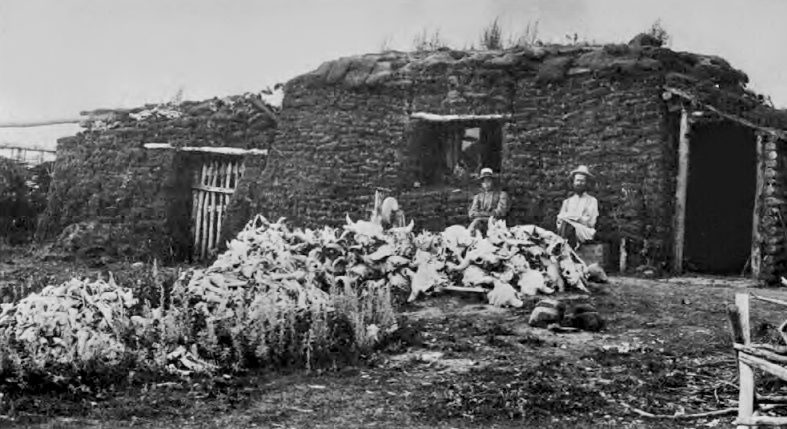
We are told of contracts being signed with fertilizer and charcoal companies for as much bone as can be brough in and of prices of $6.50 to $8.50 per ton. Barnett explains that one company, Michigan Carbon Works, out of Detroit, was created in 1873, at the height of the bison slaughter, and started making charcoal primarily to filter and purify sugar syrup. (It is from their supply yard that we get that most famous image of men standing upon a mountain of bison bones.) We're told that within ten years the company had expanded into fertilizer, glue, oil, pigments, ash and other products, all made from the same bison bones, and that each year they were producing 5,000 tons of charcoal, 4,000 tons of fertilizer, and 150 tons of glue. It is also noted that by 1894 this one company was producing 20,000 tons of fertilizer annually.
So these bones were clearly not left on America’s Great Plains but were eagerly collected, distributed, and made use of. And, like any hunt of any size, all this required great time, labour, and expense. Right. “There are no free lunches.” “Pick two.” How does any of this obvious reality fit with the typical stories that abound? Well, that’s just the bones!
If you dare to look, you can also find reference to the millions of pounds of bison meat being annually transported by train to the major cities of the midwest and east and this resource filling the nation’s refrigerated train cars and butcher shops. The Daily Milwaukee News, from Christmas of 1874 (after there were no bison to be found), for example, tells us — now get this:
…[S]till greater importance than bone-picking or hide-hunting, is the trade in buffalo meat [*ZOINKS!*] … During these five months as much as 2,000,000 pounds are shipped from the station on the Kansas Pacific to all parts of the country. In the winter months a buffalo steak can be obtained as easily and almost as cheaply in the butchers stalls of the leading northern cities as a beefsteak or a mutton chop, and in Colorado and Kansas it is as common as antelope…
The leading markets for buffalo meat “in the rough,” are St. Louis, Chicago and Indianapolis, whence it is reshipped, and cleaner and more artistic condition, to cities of the seaboard. At Kansas City, too, large quantities are cured and packed for Easter, and some successful experiments have been made in shipping direct to New York and Philadelphia on refrigerator cars. The price in the towns along the middle and eastern divisions of the Kansas Pacific ranges from $50 to $80 per ton in bulk, and the local dealers retail at six to eight cents per pound.
What would Hornaday make of two million pounds of meat being shipped out of one train station? Can we safely go ahead multiply that by three and then tack on a few million more for good measure to say there were ten million pounds of bison meat being consumed annually at this time? However the math breaks down, this is a clear and easily uncovered record of something other than the “nothing” so typically insisted upon. Even our experts and leading scholars can presumably figure out that at $50-80 per ton, the worst rate, bison meat would at least be on par with the price offered for hides, not a worthless waste left to rot, as framed.
SO WHAT?
So the story we’ve been told makes perfect sense — if you first start by slashing the bison population to just 10-20% of the most common numbers cited; contend that bison were more fragile and their range far more confined than we know to be the case; pretend the human population, transportation routes, and technology west of the Mississippi was a hundred times greater than we know it to have been; and assume there were climactic events not found in the historical record; that meat and bones were worthless while hides had ten times the value found spelled out in newspapers and archives… That's quite the story.
SOME DETAILS
Blackmore, 1877 - A Brief Account of the North American Indians
Hornaday, 1889 - The Extermination of the American Bison: with a sketch of its discovery and lifehistory
Seton, 1929 - The Lives of Game Animals (Vol III, Part II)
Garretson, 1938 - The American Bison: the story of its extermination as a wild species and its restoration under federal protection
McHugh, 1972 - The Time of the Buffalo
Dary, 1974 - The Buffalo Book: The Full Saga of the American Animal
Foster, 1992 - Buffalo
Matthews, 1992 - Where the Buffalo Roam
Smits, 1994 - The Frontier Army and the Destruction of the Buffalo: 1865-1883
Shaw, 1995 - How Many Bison Originally Populated Western Rangelands?
Carter, 2000 - Buffalo Bill Cody: The Man Behind the Legend
Isenberg, 2000 - The Destruction of the Bison: An Environmental History, 1750-1920
Stephenson et al, 2001 - Wood Bison in Late Holocene Alaska and Adjacent Canada: Paleontological, Archaeological, and Historical Records
Weber, 2001 - Historic Bison Populations: A GIS-Based Estimate
Winterer, 2022 - Working Paper No. 68, Variables Precipitating the Extermination of the American Bison
MeatEater Podcast, 2026 - Restoring Alaska's Wild Buffalo
PBS, 2023 - The Largest Destruction of Animals in Modern History | The American Buffalo


