HOLY FOX
Updated: 6 days ago
Not long after the Bank of Canada declared that the new $5 note would feature Terry Fox we also heard that a new documentary film about the kid was on the way, too. Oh and, relatedly, Bryan Adams just dropped a song titled “The Ballad of Terry Fox.” As this was happening the Terry Fox Foundation offered a press release telling us they’ve surpassed $1B in donations. Wow.
CONTEXT
I have no problem with Fox. How could I? Fox did nothing wrong, obviously. But (and this is where folks get mad at me, a truly execrable beast, so prepare your venom) I also don't think the young man accomplished anything, certainly nothing to the level of warranting a nation-wide, government-backed cult of adoration and monument-building to rival the gods of Ancient Greece. Am I wrong or is it true that Fox didn’t come close to achieving his joint aims of crossing the country and raising an equivalent of $1 per citizen as he did so? That’s no disparagement, only noticing that, like youth and beauty, not doing something is not the same as accomplishing that thing. Radical, I know. (Still, he did receive huge national recognition while alive, even being honoured with the Order of Canada.) I'm only applying the standard I would hold myself to and what we seem to require of others. Is that wrong? Do we appreciate Newton or Mozart for what they got up to in their lifetime or for what others have been inspired by or done with their work or estate in the time since? Too, like countless others, I also have many family members who died of various cancers (and who gifted funds and solicited donations toward cancer research in life and in death and who even volunteered for the Cancer Society for years). Does that make Fox’s efforts look more like epic heroism or normal, everyday stuff?

With that disposition and set of acknowledgements, I’ve also written before about what I consider to be a weird cult in our midst and about the billion dollar industry swirling around it, both of which I see as exploitative or at minimum wasteful. I’ve written about how Fox has been memorialized with four previous feature-length films and television specials as well as six previous songs and two dozen books. I’ve spelled out how, in addition to all that, there are 32 roads and streets, 14 schools, 14 athletic centers and community facilities, 13 municipal and provincial parks, a mountain and 9 hiking trails, a coast guard icebreaker, a strip mall, an award, a commemorative coin and postage stamp, and, of course, statues and plaques with his name throughout the country. There was also a recent push, by the cult, to have Vancouver’s airport renamed after Fox and a bunch more streets in Toronto and Ottawa, too. And all of this revision, construction, maintenance, and renewal, of course, comes at a great public expense, to the tune of many millions [billions?] of dollars because, obviously, the Terry Fox Foundation has all its donations restricted for “cancer research” — which we will get into.
That seemed to me like a lot. Why? Well, contrast this volume with the fact that there are just 6,000 memorials nationwide for nearly a million who were conscripted and sent overseas in the first half of the 20th century and the more than 100,000 who died. I always felt that was a crazy level of memorialization until I realized what they were doing with Fox. Or where are the memorials in every city to Osler or Banting, Penfield or Hubel whose work and innovation revolutionized medicine and saved countless lives and continue to do so?
(If municipalities need heroes to build monuments to or name hospitals or parks after I can provide lists… Also, do the Fox people know Canada has more lakes than we can name and there’s still none with Terry’s name on it? And while there is a fox constellation, I don't think there is a Terry Fox constellation yet. Why not? And what about renaming one of the elements on the periodic table? Element 52 "Te" is Tellurium but we all know it should be Terryfoxnium. Obviously. Just makes sense.)
I’ve also compared Fox with Steve Fonyo in the past and noticed how, inspired by Fox, he actually crossed the country, unlike Fox; and, also unlike Fox, did so without any huge corporate sponsors (Ford, Imperial Oil, Adidas) and no backing or mere blessings from the Canadian Cancer Society, who were actually hostile to Fonyo. And I’ve written about how Fonyo managed to raise ten times the money Fox did and then went on to the UK and did the same there all while being, by comparison, largely shunned and forgotten.
All of this information only ever arouses consternation and, actually, real anger in people (just on the odds you’re likely one of them.) I never understood that. Aren’t you trying to make sense of this from Fox’s perspective and by imagining what you would have wanted were you in his sneakers? How else would you try and look at all of this? I mean, didn’t the kid seem humble? Doesn't everything ever written about him tell you this? And didn’t he turn down all the additional funds, product placements, and advertisements he could have gotten? And for decades haven’t all of his wishes been disregarded or sidestepped?
Hasn’t Adidas, for instance, issued regular memorial running shoes under the Fox name with foundation blessing? Of the shoes, didn't Martha McClew, chief operating officer of the Foundation tell us, most disgustingly, “It was quite amazing to think what powered the man across Canada had never really been noticed or seen [until Adidas issued a remake of his shoe as a fundraising gimmick in 2005].” Yes, it was Adidas shoes that propelled Fox. *Groan* And don’t they sell for $150 a pair and when sold out may be found on resale sites asking $1,500, none of which is going to cancer research? Is any of that what Terry would have wanted? Or would he think it was gross? I have a guess.
And doesn’t the foundation bearing his name also partner with the trashy Giant Tiger store? And don’t they use this relationship for their marketing and corporate responsibility PR BS? (If you were to go look you might find in their impact statement on their website they merely solicit donations from the public, not even amounting to $2 per day per store, and do not invest corporate profits. They don’t even link to the Terry Fox Foundation or provide a donation button to any cancer research organizations. That’s not just bizarre, highlighting how they’re contributing nothing while pretending they’re saving lives, but should tell you exactly how much they care about Terry Fox the person, this foundation, and funding cancer research…) And you think corporate sponsorship, from a junk store of all places, is needed to get kids to run around an elementary school? Not in my day. And do you think Terry would love that? I don’t. I don’t think he’d be down at all. But what do I know?
QUESTIONS
In light of these latest offerings and revelations (of more films, songs, bills, and now a billion raised), I’ve started asking people serious questions. Things like:
Do you think the Canadian Cancer Society or Terry Fox Foundation are doing good work with their literally countless billions in donations?
Do you believe we’ve seen a radical reduction in carcinogens, cancer cases, cancer fatalities, or the arrival of cures for cancer here in Canada thanks to the money brought in by our major cancer charities and non-profits?
Would it matter to you, and should it matter to these organizations and those granting them public funds, if the money collected to eliminate cancer has doubled or even shot up ten times (along with their assets, paid staffing numbers, and salaries, and all resulting in a track record of terrible charity efficiency) while the raw cancer numbers, cancer rate among the population, number of cancer deaths and/or rate of cancer deaths had stayed the same or even dramatically worsened over the last 50 years?
There is no universe in which I would want my name or likeness plastered all around — even if I cured all cancers on my own in what everyone agrees was the greatest application of the human mind and yielding the greatest reduction in human suffering in the history of our species. If I were a ten-time Olympic gold medalist, won the Nobel Prize in physics twice, became Prime Minister, and then followed that with a successful film and music career, winning a Genie and a Juno, and then donated my life’s earnings to charity, certainly the Order of Canada would be a lot of additional recognition, to my mind, while statues in ten cities and a mountain with my name would seem beyond over-the-top. Ask yourself, how long your list of real, outstanding life achievements would need to be (and how gargantuan your ego) to wish for scores of monuments and works (and ships and airports and arenas and landmarks) in your name from sea to shining sea?
ATTEMPTED ANSWERS
The Canadian Cancer Society’s stated aim is “increasing cancer survival, stopping cancer before it starts and improving the lives of people affected by cancer.” That is similar to the Terry Fox Foundation who tells us their vision is: “Bringing Canadians together to realize Terry Fox’s dream of a world without cancer.” So how is all that going after nearly a century of the society and 50 years of this foundation? Are these organizations responsible for radically reducing carcinogens and exposures to prevent cases or funding the very research yielding novel cancer screening, treatments, and cures and thereby reducing misery and fatalities? That seems pretty easy to track down.
Without looking at any numbers, when I consider the situation it feels like just in my lifetime we’ve dramatically increased our awareness of and education around cancer and paired that with serious monitoring, reductions in harmful substances and behaviours, and also improved testing and treatment. Seems obvious. In fact, the difference since Fox’s time and the present feels rather stark. It’s hard to look back, even having been there and done that, and understand how we ever sat in smoke-filled workplaces and restaurants, automobiles and airplanes (with yellowing, tobacco-soaked ceilings, wallpaper, seating, and carpets…) or how half the staff and kids at every high school spent some part of every day in the “smoke pit” or out behind the parking lot. Bonkers.
And, just since the 1980s, hasn’t there been an explosion of cancer screening and environmental testing, dramatic reductions in smoking and improvements to air quality, development of full-spectrum sun screens, the banning of many known and suspected carcinogens (like asbestos, DDT, and PCBs as well as cancer-causing artificial colourings, flavourings, and sweeteners)? And then didn’t we also see the arrival of near-miracles like the Hep B vaccine and HPV shot? I think so. I think I watched all that happen.
Still, none of that was brought about by Canadian cancer charities. Okay, but surely that momentous revolution in health and medicine means we’ve seen significant declines in cancers and cancer deaths, right? …RIGHT???
Well, depending on what sources you look at, here in Canada it appears we had around 425 new cancer cases per 100k people each year in Terry Fox's time and today the rate sits at about 615 (up 45%). The crude cancer death rate went from around 175 per 100k in the mid-1980s to 210 in the 2020s; with the real numbers going from 46,333 cancer fatalities in 1985 to 87,400 in 2025. That means that while the population grew by ~60% deaths from cancer jumped ~90%. That doesn’t look good, not good at all.
But folks in the cancer world, and barking at me on the-social-media-platform-formerly-known-as-Twitter, always like to look at these numbers and highlight that the population hasn’t just grown but aged significantly, too. And with that they want to shift all the numbers into age-adjusted terms. This, to me, is not compelling as the stated aims of “increasing survival”, “stopping cancer”, or “a world without cancer” is not an age-based goal and we’ve always known that Boomers were and will always be the largest cohort and were always planning on aging, too. And then, even while age-shifting the data, this reframing also doesn’t result in the elimination of or even serious declines in their annual reports or those from Statistics Canada but instead show things mostly looking worse, even far worse, or at best remaining pretty steady over time.
Yes, there have been some real positives such as the reduction in age-standardized mortality for stomach and colorectal cancer for all of us, breast cancer in women, and lung cancer in males. Great. Though there has been a dramatic reduction in lung cancer among males from 40 years ago, cases are way up for women. Is that a huge win? And though ovarian cancer is down a little, when adjusted for age, melanoma incidence has steadily risen by 2% each year for the last 30 year for women while thyroid cancer has positively exploded.
So how are people under age 50 doing? Well, most sources agree they are twice as likely as prior generations to be diagnosed with cancer. Particularly bad is breast cancer among women in their 20s, which has increased by about 45%, and colorectal cancer risk for everyone this age hovers around 2.5X higher than the seniors currently succumbing to their cancers. Sure, all this increase could merely be better sensitivity in our testing equipment or greater eagerness for doctors to test and people to seek testing. I don't know. All I know is it doesn't look anything like number-go-down. And the rise in cancer-related fatalities doesn't suggest we're close to being cancer-free.
In fact, the same cancer charity reporting tells us that "the predicted 5-year net survival for all cancers combined is 64%." However, not only is there no good data going back even just 40 years, with registries beginning in 1992, but also no 10-year survival data exists for just the duration of my own lifetime. And even then the numbers we do have suggest the difference in predicted 5-year survival between the present and ancient history — when I was born and the whole of the world was hosed down with PCBs and DDT, we surrounded ourselves with asbestos, and we had leaded everything, and everyone was smoking and sunbathing — is an improvement of about 10%. Using just Ontario data, it looks like the improvement in 10-year survivability for all cancers between the '90s and today is about 4%. All that doesn't look like an elimination or dramatic “reduction” in cancers and it doesn’t make the last 50 years and many billions in donations to these and adjacent NGOs seem to have yielded any medical miracles.
It’s weird how this scenario appears almost identical to those claiming they’re fiercely focused on bringing in low-cost housing, reducing and ending homelessness, eliminating hunger, poverty, substance abuse, or drug overdoses — while the numbers climb with every new intervention and program introduced (and as they expand their federal and provincial funding, their staffing, their fleet of vehicles, and their real estate procurement.) I’m going to have to start a charity or community aid program where our stated aim is to NEVER do the thing. Maybe then we can make some headway.
Okay, so what about the money?
NON-PROFIT?
What’s happening inside these NGOs? I don’t really know, of course. All I can do is look at what they offer us. And what’s online is only recent data. Still, the numbers are surprising to me. It looks to me like 20 years ago the Terry Fox Foundation had $17M in the bank, around $18M in total assets, and a staff of one or two dozen. Today, for some reason, they have $50M in cash (+194%) and $92M in assets (+411%) and more than 70 staff (+250%), including people earning at or above $250k annually (equivalent to an eye surgeon or a senior software developer at Google.) Similarly, the Canadian Cancer Society had a staff of 70 back in 2006, with $5M in the bank and assets valued at $9M; today, just 20 years later, they have around $200M cash (+3,900%) and $300M in total assets (+3,200%) along with almost 1,000 paid staff (+1,200%), with $210M in revenue, many millions annual consulting fees, $75M going to staff, some of those staff earning over $250k (or a million bucks just since COVID ended) and their CEO taking $416k annually.
Without any additional information, that looks like tremendous growth to me. When I consider how long it would take to turn $5M into $200M by conventional conservative investing, using something like the growth in the S&P 500 as a guide, an inflation-adjusted estimate would land at around 55 years to see the same performance. I hope you’ll agree that makes this jump, in just 20 years, pretty impressive for a non-profit charity — one with nothing to sell and no new pitch to deliver to their donors ("Cancer bad." *Gasp* "Have you tried NOT having cancer?" *Stupefied*)
As if being run by a private equity firm, they grew so fast by swallowing up other cancer charities and axing services they’d provided for decades and that Canadians had come to rely upon. They eliminated these services, ones patients were furious about losing, over “cost” and did so knowing better than anyone that almost all their funding comes from the public (and especially cancer survivors and the families of those lost to cancer.) Totally nuts. According to press reports the Cancer Society did this “to preserve its viability at a time when the charity sector is facing declining donations” which, by the numbers, looks laughable. (Also, as I was writing about a year ago, did you know that the NGO world has more cash and assets, twice as much in fact, than all the corporations you can name?) As their cash and assets of the Cancer Society went through the roof and beyond, they killed or reduced programs including those they weren’t really paying for, like their volunteer drivers who would deliver patients to treatment. They even amended a program providing subsidies to cancer patients for travel expenses, limiting the eligibility criteria to only those earning less than $20,000 a year (below minimum wage) and while knowing that even at minimum wage (above their new threshold) people cannot even cover rent, never mind expenses… And they did this while slashing their traditional "boots on the ground" regional staff numbers and increased their admin assistants, business analysts, fundraising specialists, digital and IT specialists, and marketing and communications teams. Wild. Just wild.
Also wild is their expenditure breakdown. Audits show the Canadian Cancer Society spends about 38% of what it brings in on its own operations, delivering roughly $0.62 for every dollar donated (the Terry Fox Foundation spends 25% and delivers $0.75). The most cost-efficient major organizations in Canada operate with an average overhead of just 18% while the baseline for all charities in Canada is 26%. The Canada Revenue Agency recommends a charity's fundraising costs remain below 35%. So this 38% also pushes the Canadian Cancer Society outside what auditing organizations like Charity Intelligence flag as a "reasonable range" for donor cost-efficiency. Amazingly, this charity, one of Canada's largest and oldest, also has its impact evaluated as: "no yet rated". This leaves the Canadian Cancer Society earning three out of five stars for their overall rating and nowhere near the top 100 charities in Canada. Ouch.
SO WHAT ARE THEY FUNDING?

The Cancer Society tells us that in recent years they’ve spent between $40-$50 million annually funding almost 500 research projects and clinical trials. When I try to find out what good this money has done, billions over the years, all the sources cite the Canadian Cancer Society website. (Never a good sign.) There they choose to highlight the development of the drug vinblastine, a treatment for Hodgkin lymphoma derived from a periwinkle plant from Madagascar and said to be a miracle cure. When I look up who was responsible for it and when, yes, it was a pair of Canadian researchers but way back in 1958. When I look up what it does and how it is used (off of the CCS website) I find that vinblastine was never given to cancer patients alone but as part of a whole cocktail of drugs and immunotherapies, because it alone doesn’t do the trick. And then I also learn that the EU dropped Vinblastine as part of their Hodgkin lymphoma protocol way back in 1992 for being problematic and significantly less effective than other drugs. And, to be clear, according to the CCS themselves, Hodgkin lymphoma is the cancer with the largest annual age-standardized rate increase in males. Agains, that's quite the thing to point out for us.
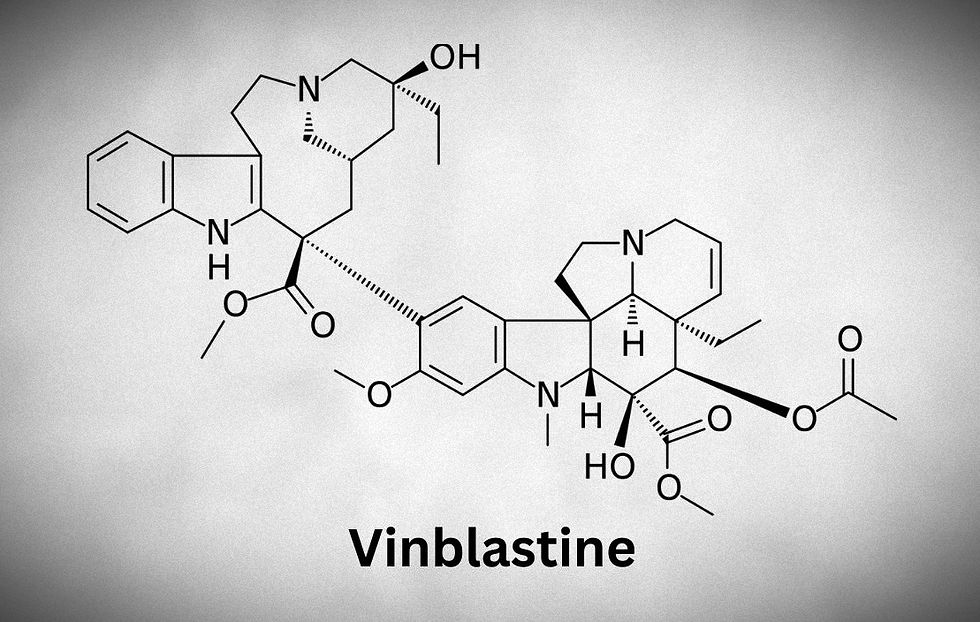
Side effects include:
• Increased risk of serious infections, low white blood cell counts, bruising or bleeding, nausea, vomiting, diarrhea, mouth sores, significant constipation, hair loss, nerve pain or numbness.
The Canadian Cancer Society also highlights as one of their funded cancer treatments cobalt-60 radiation therapy (aka "the cobalt-bomb"), developed at the University of Saskatchewan in 1949. Though these machines were sexy and state-of-the-art in the nuclear age, back in the 1950s, they were constantly emitting lethal gamma radiation within their protective housing, presenting a perpetual safety hazard in the event of mechanical failures, hospital fires, or structural collapses. And because the radioactive core of cobalt-60 has a half-life of just five years, every hospital using them had a financial, bureaucratic, and environmental burden of regular decommissioning, extraction, transportation, and safe disposal of spent nuclear waste. Where they weren't eliminated for the radioactive headache they posed (and for causing more harm than good), they were largely discontinued because it became way less cool to have weapons-grade nuclear materials just lying around in every hospital, especially after Sept 11, 2001. So, again, a strange thing to highlight.

This drug and this "bomb" are, as far as I can tell, nothing like cures for cancer, as framed, and most certainly not something my cancer charity funds nor yours helped develop. More than that, well established in a vast literature is the reality that many cancer patients — certainly those between the 1970s and the early 2000s (the majority of the life of these two NGOs) but also still today — treated with the very anti-cancer drug cocktails, radiation, and surgery said to be “saving” cancer patients’ actually caused permanent, progressive cellular damage and spread their cancer (referred to in the literature as "iatrogenic tumor seeding" *Barf*) or caused other fatal conditions. In fact, recent studies show subsequent malignancies in "survivors" constitute around 20% of all cancer diagnoses today. So it seems doubtless that future generations will look at these "modern" treatments for cancer as we look upon bloodletting or the mercury-based universal curatives of the 18th and 19th centuries.
To me, the above realities coalesce into what seems like a strong signal of mission drift and, well, mission abandonment. With primary goals shifting from curing and preventing cancers (which have gotten worse on many fronts even as we’ve cleaned up the environment and our habits) to preserving the institution, bringing in more money, and supporting a vast network of thousands of researchers who depend on their dollars — too many of whom are not the folks you’re thinking about and don’t even do cancer science or investigate new screening methods, treatments, or cures but who take $500k to study the efficacy of no-smoking signs on busses or trying to create AI tools to help people find cancer services (that have been taken away) and stuff of this sort that very much smells to me like BS.
Further evidence for this is that these NGOs like to remind us that tobacco use, for instance, remains the leading cause of preventable cancers and cancer deaths, responsible for around 30% of all fatal cancers and the overwhelming majority of lung cancer cases. Seems worth asking how many more centuries we need to wait to phase out the selling and smoking of tobacco products, especially with all the nicotine-based alternatives to cigarettes that come with none of the dozens of known carcinogens in a pack of smokes? I mean, Mexico, Ireland, Singapore, and even the Maldives and Bhutan are way ahead of us on this. The CCS and TFF have no lobbying power compared to Mexican and Irish NGOs? What is it? The feds are making too much money through taxing tobacco products to justify ceasing the practice of allowing people to sicken and kill themselves (and at great taxpayer expense) in the same manner they did in the 1940s? I mean, how are cigarettes still around when they are so much more dangerous than kitchen floor tiles or roofing shingles made with asbestos?
What are we doing, people?
What are these cancer organizations doing?
And what are we doing supporting them?
And then, holy f*ck, why are we still building monuments to this kid and finding new ways and modes by which to memorialize him? Has nobody done anything in 50 years?
As ever, I have questions.